
Unifying Natural Heritage for a Resilient Future
Wouter Addink · Sustaining the Geo- and Biodiversity Data Ecosystem: Standards-Driven Approaches to Long-Term Resilience
Summaries and key moments are machine-produced. Check the recording for the speaker’s exact words.
The short versionDiSSCo's ERIC model and FAIR digital specimen objects are intended to make Europe's specimen data resilient beyond short-term project funding.
What this was about
Wouter Addink used Shackleton's Endurance expedition as a parable of resilience (acting immediately and protecting the most precious assets) before presenting DiSSCo. He explained that only about 10% of Europe's estimated 1.5 billion specimens are digitised, and that DiSSCo aims to industrialise digitisation and create one FAIR, machine-actionable European virtual collection built around the Digital Extended Specimen as a citable FAIR digital object with a DOI. He argued that the ERIC legal model, with member-state financial and governance commitments, frees data from project-cycle dependency.
Why it matters. Specimens provide evidence for biodiversity loss, climate change and health research, and a long-term legal and funding structure is presented as the answer to data loss when project funding ends.
In the room
- Resilience means taking immediate action and focusing on preserving the most precious assets, illustrated by Shackleton's expedition.
- Specimens are evidence for biodiversity loss, climate adaptation and pathogen/health research.
- Only about 10% of an estimated 1.5 billion European specimens are digitised.
- The DiSSCo digital specimen is a FAIR digital object with a DOI, containing catalogue data and links to derived and related data.
- The ERIC model provides long-term governance and financial commitments from member states, beyond project-cycle dependency.
- DiSSCo has submitted its step-two ERIC application, with six founding countries, aiming to launch next year; over 400 institutions from 23 countries are involved.
Notable moments
Transcript
Automatically generated captions can contain mistakes, especially in names and technical terms. Times are relative to the room recording.
Read the transcript ↓
Related talks.
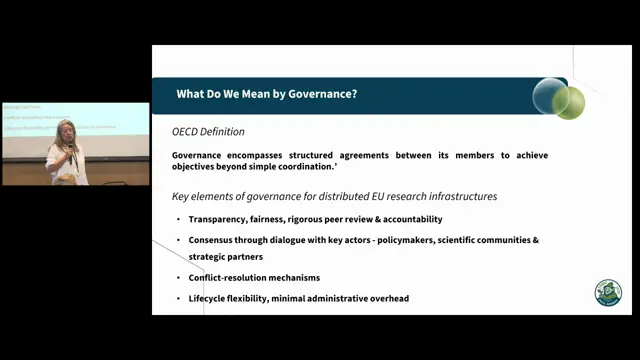
Governance as a Foundation for Resilient Biodiversity Data Infrastructures: Lessons from DiSSCo
Inclusive, funder-connected governance designed into a research infrastructure from day one is a core ingredient of its resilience.
Sustainability and collaboration in a time of uncertainty
Sustaining biodiversity data infrastructure requires treating technology, people and a diversified funding portfolio as one interconnected system.
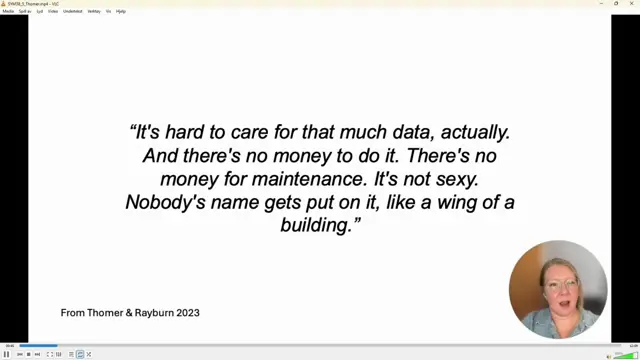
From preservation to perseverance: bridging disciplines for data resilience
Data resilience in a crisis is about prioritisation and mutual aid rather than perfection, and infrastructures need to be kept appropriately visible to be funded.