
Handling evidence: a cross-disciplinary perspective
Dmitry Schigel · Publishing and Communications Promoting Biodiversity, Natural History Collections, People, Data and Data Standards
Summaries and key moments are machine-produced. Check the recording for the speaker’s exact words.
The short versionBiodiversity standards should stop treating what was recorded and what was concluded as the same kind of fact, borrowing evidence-handling practice from forensics, archaeology and medicine.
What this was about
Dmitry Schigel argued that TDWG standards treat the registration of biodiversity evidence as a flat layer that mixes primary detections with interpretations. Using examples from direct versus circumstantial evidence and a grammatical-tense analogy (living organism, shed skin, eDNA, eRNA), he showed that different evidence supports different inferences, and noted that specimens and samples span a wide range of evidence types. He surveyed how forensic science (Locard's principle, chain of custody), archaeology (context recorded before interpretation, Harris Matrix) and medicine (evidence pyramids, GRADE) separate what was recorded from what was concluded, and proposed that standards evolve to separate detection terms from interpretation terms and carry explicit confidence for identifications.
Why it matters. As sensors, eDNA and AI inflate the volume of evidence, explicitly separating detections from versioned, attributable interpretations and grading evidence quality would make data more trustworthy for policy decisions such as Red List assessments.
In the room
- Biodiversity recording involves detection, interpretation and registration; TDWG standards register both neutrally in one flat layer.
- Direct evidence varies: an observed organism (present tense), exuvium (past), dry eDNA (present perfect) and eRNA (currently functioning) support different inferences about presence.
- In Darwin Core, instrument readings such as coordinates sit alongside interpretive annotations such as scientificName and identifiedBy with equal status; an occurrence is a detection event plus a taxonomic decision.
- The flat format was a deliberate, successful historical choice (billions of records), but pressure now grows for richer models such as the Darwin Core Data Package and the Humboldt Extension.
- Specimens and samples range from single individuals to tissue, bulk and 'blind' eDNA samples; sequence data inherit evidence from physical samples.
- TDWG shares roots with library science but now has little exchange with GSC or ISO, risking professional encapsulation.
- Forensics logs every evidence transfer; archaeology records context before interpretation and keeps field records, reports and interpretations as separate citable layers; medicine's GRADE separates evidence quality from recommendation strength.
Notable moments
Transcript
Automatically generated captions can contain mistakes, especially in names and technical terms. Times are relative to the room recording.
Read the transcript ↓
Related talks.
Address from the TDWG Chair: highlights of the year and TDWG at a crossroads
TDWG has had a productive year, but a growing, more diverse community and the rise of AI put it at a crossroads that needs more volunteers, better documentation and more sustainable maintenance and funding.
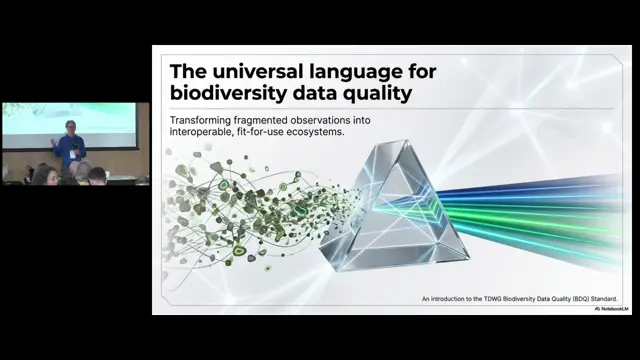
An Introduction to the Biodiversity Data Quality Standard (BDQ)
BDQ provides 110 standard, use-case-linked tests so that data quality can be assessed consistently from collection to aggregation.
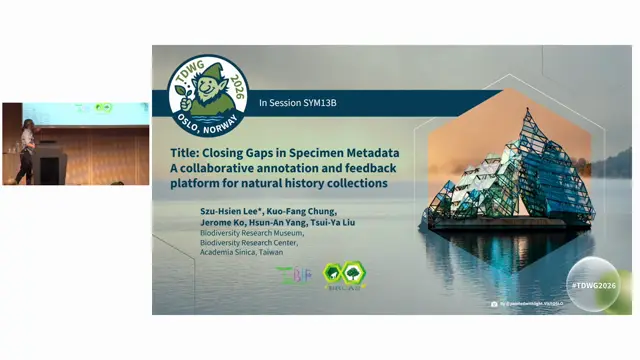
Closing Gaps in Specimen Metadata: A Collaborative Annotation and Feedback Platform for Natural History Collections
A national collaborative annotation platform with AI-assisted transcription can close metadata gaps across many Taiwanese collections.