
The United States contribution to the global taxonomy of the Catalogue of Life in the first quarter of the 21st century
Yury Roskov · National & Global Taxonomic Backbones
Summaries and key moments are machine-produced. Check the recording for the speaker’s exact words.
The short versionUS experts and platforms supply over a third of the Catalogue of Life, and the next step is an identifier-based infrastructure passing unchanged IDs between databases.
What this was about
Yury Roskov opened with a tribute to Frank Bisby, co-founder of TDWG and the Catalogue of Life (Species 2000), then summarised growth from 200,000 species in the first 2001 edition to 2.2 million accepted species from 158 expert global species databases (GSDs), plus an extended release adding over 220,000 species. His analysis shows US-based GSDs and US-hosted platforms contribute about 820,000 species (36%), with ITIS supplying the management classification and over 158,000 species, and Species File and other TaxonWorks-hosted checklists contributing substantially. He closed with a vision of a global infrastructure where persistent identifiers for names, specimens and references are passed unchanged between databases and aggregators, each adding metadata, possibly using blockchain-like transparent transactions.
Why it matters. Documents how the global taxonomic backbone is built and argues for provenance-preserving identifier infrastructure rather than repeated dataset copying.
In the room
- Catalogue of Life base release reached 2.2 million accepted species over nearly 25 years; the extended release launched publicly this year adds over 220,000 species mainly in gaps.
- 158 GSDs curated by experts are arranged in a management classification; about two thirds of the catalogue is updated each year.
- US-based GSDs contribute about 820,000 species (36%); initially ITIS supplied about half.
- ITIS provides the global management classification that avoids overlaps and reveals gaps, and supplies over 158,000 accepted species.
- 12 Species File checklists maintained in TaxonWorks contribute over 81,000 accepted species; other TaxonWorks-hosted and processed datasets include ScaleNet, Systema Dipterorum and others.
- Vision: pass global unique identifiers for names, specimens and references unchanged along the chain (nomenclator -> taxonomic database -> CoL -> GBIF), extending metadata at each step, so changes propagate and providers see usage metrics.
Notable moments
Transcript
Automatically generated captions can contain mistakes, especially in names and technical terms. Times are relative to the room recording.
Read the transcript ↓
Related talks.
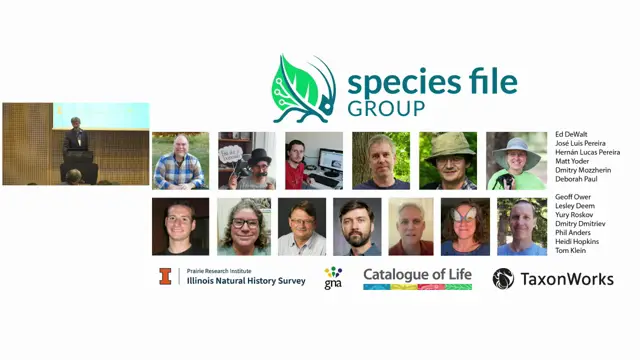
Experience of collaborative management of the World Auchenorrhyncha Database in TaxonWorks
TaxonWorks turned a personal taxonomic database into a collaborative, well-connected resource feeding Catalogue of Life, GBIF and iNaturalist.
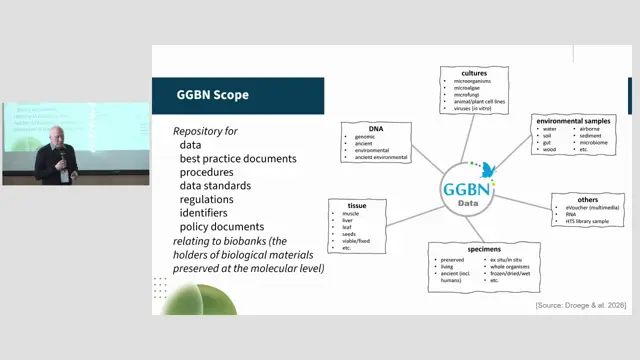
Rebuilding core functionalities of the GGBN system: taxonomic alignment with international research infrastructures
GGBN is rebuilding transparent automated name parsing and matching on GBIF parsing and ChecklistBank/Catalogue of Life XR to improve sample discovery.
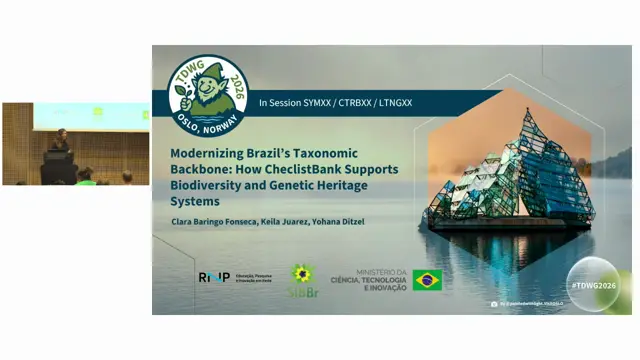
Modernizing Brazil's taxonomic backbone: how ChecklistBank supports biodiversity and genetic heritage systems
ChecklistBank lets a small national node assemble one consistent taxonomic backbone for legal, portal and permitting systems.