
Experience of collaborative management of the World Auchenorrhyncha Database in TaxonWorks
Dmitry Dmitriev · Digitizing Collections & Legacy Data
Summaries and key moments are machine-produced. Check the recording for the speaker’s exact words.
The short versionTaxonWorks turned a personal taxonomic database into a collaborative, well-connected resource feeding Catalogue of Life, GBIF and iNaturalist.
What this was about
Dmitry Dmitriev described how the World Auchenorrhyncha Database (leafhoppers, planthoppers, cicadas and relatives) grew from a largely single-person project into a collaborative one after migration to TaxonWorks, now with 66 registered users. He toured the TaxonPages public interface: species pages with synonymy, nomenclatural history, type information, specimen- and country-level distribution maps, downloadable distribution records, host-plant associations, iNaturalist images, interactive and dichotomous keys generated from morphological matrices, and pictorial image matrices built from contributors' 28,000 images. Data flow to the Catalogue of Life and GBIF, and iNaturalist now pulls the classification directly from the TaxonWorks API; feedback arrives through GitHub issues.
Why it matters. An example of how a modern taxonomic platform supports collaborative curation, identification tools and downstream data sharing for a large insect group.
In the room
- TaxonWorks is an open collaborative platform for taxonomy, collections, identification tools and bibliography; the Species File Group also works on TaxonPages, Catalogue of Life and Global Names.
- 66 registered users; some join mainly for the advanced filtering tools.
- Higher-taxon distributions are aggregated from included species; all data are downloadable.
- Dichotomous keys can be built from morphological matrices; image matrices provide pictorial keys.
- A contributor uploaded 28,000 images in about two years.
- Comparison with the CoL extended release shows about 200 extra species (down from 500), likely misspellings or historical combinations; CoL validations partly complement TaxonWorks' nomenclatural validation.
- iNaturalist harvested web pages until pointed to the API; it now uses the TaxonWorks classification directly.
Notable moments
Transcript
Automatically generated captions can contain mistakes, especially in names and technical terms. Times are relative to the room recording.
Read the transcript ↓
Related talks.
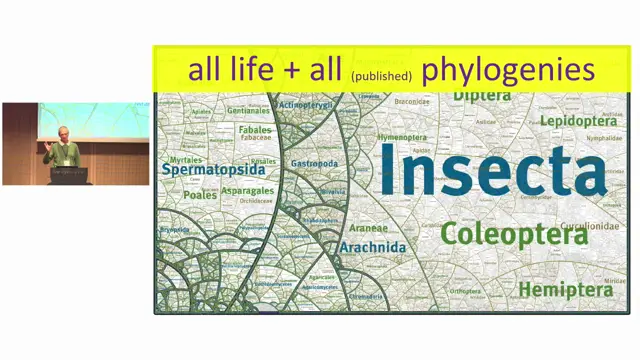
LifeGate: Extending a Global Visual PhyloMap into a Structured Biodiversity Knowledge System
LifeGate's visual map of all described species will become an open, connected knowledge system with trait-based faceted search built from AI-assisted literature extraction.
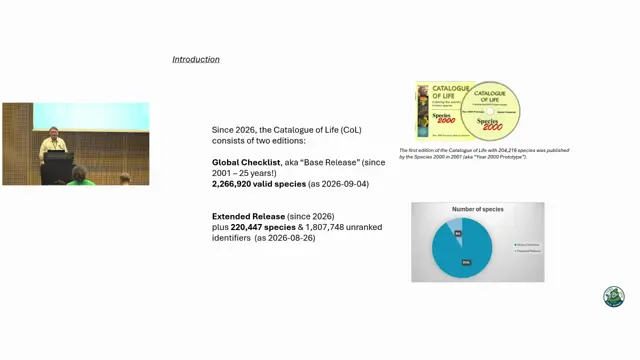
The United States contribution to the global taxonomy of the Catalogue of Life in the first quarter of the 21st century
US experts and platforms supply over a third of the Catalogue of Life, and the next step is an identifier-based infrastructure passing unchanged IDs between databases.
Approaches to the Automated Tracking of Taxonomic Research Activities
TETTRIX aims to build a machine-run, regularly updated picture of who is doing taxonomy on what and where, and is asking the community which sources it is missing.