
A species-level taxonomic catalog of Neotropical freshwater insects: building a consensus reference for occurrence data integration and conservation planning
Alejandra Correa-Bedoya · A consensus taxonomic reference for improved freshwater biodiversity data and knowledge
Summaries and key moments are machine-produced. Check the recording for the speaker’s exact words.
The short versionWithout a reliable species-level checklist, Neotropical freshwater insect occurrences, distribution models and conservation arguments cannot be built.
What this was about
Alejandra Correa-Bedoya presented a Darwin Core-compliant species-level checklist of seven orders of freshwater insects for the Neotropics (southern Mexico to Brazil), compiled over six months for her PhD. She showed that names documented for Colombia (about 1,250 species) often have no occurrence records there, due to taxonomic resolution bias and a data supply gap rather than platform failures, verified names against global infrastructures, and noted her list triples known Odonata species for Colombia compared with a national effort. Grounding it in the free-flowing Samaná Norte river, threatened by planned dams and invasive species, she argued that without species names there are no occurrences, no species distribution models and no evidence for protecting rivers.
Why it matters. It links taxonomic infrastructure directly to conservation decisions under dam development pressure in one of the world's most biodiverse and data-deficient regions.
In the room
- Global freshwater populations declined about 83% since 1970 (Living Planet), about 95% in Latin America and the Caribbean; Central and South America are data-deficient hotspots.
- Dam expansion is concentrated on the Andean slopes, modifying flows before data exist to assess losses.
- The checklist covers seven orders from southern Mexico to Brazil, excluding the southern cone as a distinct biogeographic region; Coleoptera and Diptera are richest.
- It is a taxon-core list (names, synonyms, classification) of officially described species, the naming backbone needed before occurrence data can be resolved.
- Colombia has the most documented species of these orders (about 1,250), reflecting its position among heterogeneous biogeographic subregions.
- Example stonefly: GBIF shows records across its range but none in Colombia at the range centre, indicating nobody has named and looked for it there.
- Verification against GBIF found flags such as recent nomenclatural changes (Coleoptera), typographic/algorithmic errors (Trichoptera) and a genus reassignment (Hemiptera); she frames this as a data supply gap, not a platform problem.
Notable moments
Transcript
Automatically generated captions can contain mistakes, especially in names and technical terms. Times are relative to the room recording.
Read the transcript ↓
Related talks.
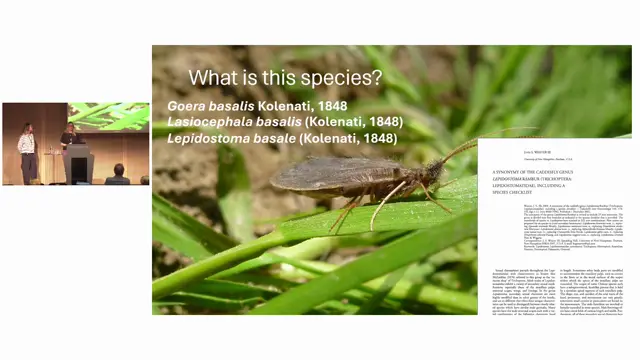
Not just another database: building the future of freshwater taxonomy with FADAtims
FADAtims turns the dormant FADA checklists into a living, expert-curated and interoperable freshwater taxonomic infrastructure, but its future depends on sustaining experts and systems.
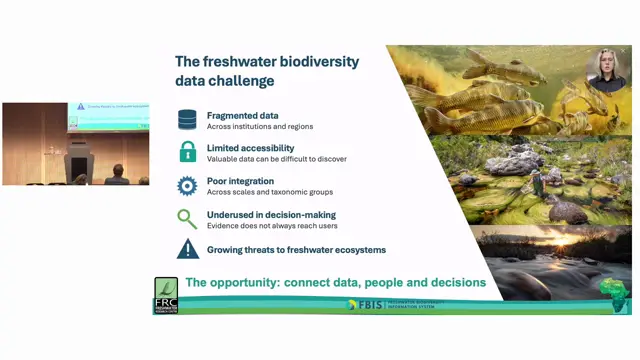
Biodiversity data at your fingertips: open-access freshwater biodiversity information systems for South Africa and Africa
Co-designed, open and interoperable freshwater information systems like FBIS turn fragmented records into decision-ready information, and multi-tenancy helps keep them sustainable.
A collaborative perspective on a globally standardised river basin name database
Freshwater biodiversity data need a global, multilingual, collaboratively maintained river basin naming system, and TDWG, Wikidata and OpenStreetMap could build it together.