
BMD workflow engine: FAIR workflows, RO-Crate and FAIR Signposting for a European biodiversity data space
Lena Perzlmaier · Operationalizing Biodiversity Digital Twins within Data Space Ecosystems
Summaries and key moments are machine-produced. Check the recording for the speaker’s exact words.
The short versionPackaging containerised workflows and their runs as RO-Crates with FAIR Signposting lets non-technical users run models remotely and get machine-actionable, citable results.
What this was about
Lena Perzlmaier presented the workflow engine developed in Biodiversity Meets Data, motivated by letting a Natura 2000 site manager reuse a scientist's species distribution model. She argued that scientists should share code, containerise it, and define a workflow (BMD mainly uses Argo), described with Workflow RO-Crate (prospective provenance) and Workflow Run RO-Crate (retrospective provenance). A central RO-Crate service links user interfaces, execution engines (Workflow.earth on Destination Earth, and the BMD platform's engine at LifeWatch ERIC) and registries, and runs are exposed as FAIR Digital Objects by combining identifiers, RO-Crates and FAIR Signposting.
Why it matters. It shows a concrete path from 'share your code' to reusable, remotely executable and provenance-rich workflows, which is the practical substance behind data space rhetoric.
In the room
- Motivating example: an ecologist's species distribution model reused by a Natura 2000 site manager interested in invasive species spread.
- Steps asked of scientists: share code, containerise it, and define a workflow of inputs, steps and outputs; BMD mainly uses Argo and has considered CWL.
- Workflow runners can execute on remote infrastructure, so site managers need not run models on limited local hardware.
- Workflow RO-Crate adds licence, authorship, description, language and formal inputs/outputs (prospective provenance); Workflow Run RO-Crate adds a CreateAction with agent, actual parameter values and output files (retrospective provenance).
- A central RO-Crate service unpacks submitted crates, sends manifests to workflow engines and repackages run results as run crates that can be published to registries (BMD data space, WorkflowHub, Workflow.earth).
- Workflow.earth, deployed in Destination Earth, was the first implementation, focused on agricultural digital twins; the BMD platform's engine runs at LifeWatch ERIC.
- FAIR Signposting exposes metadata to machines in HTTP headers; combined with a unique identifier and RO-Crate, runs become W3C-style FAIR Digital Objects.
Notable moments
Transcript
Automatically generated captions can contain mistakes, especially in names and technical terms. Times are relative to the room recording.
Read the transcript ↓
Related talks.
The BMD Cubing Engine: Harmonizing Biodiversity and Earth Observation Data
BMD's cubing engine turns a declarative YAML recipe into reproducible, provenance-documented data cubes that harmonise GBIF occurrences with climate and Earth observation data on one grid.
Challenges and Opportunities for FAIR Marine eDNA Data Publication Workflows
Making marine eDNA data FAIR is as much about clear, practical, less manual publication processes as about technology.
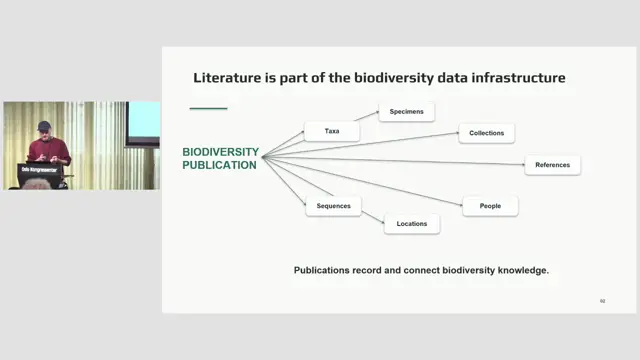
Biodiversity literature as FAIR and AI-ready data by design (and how to get there)
Don't just liberate biodiversity literature, publish it liberated.