
The Unruliness of Higher Geography: What is it doing for us?
Erica Krimmel · Solutions for Research Collection Management Systems Challenges
Summaries and key moments are machine-produced. Check the recording for the speaker’s exact words.
The short versionDarwin Core needs more explicit, time-aware ways to share human and physical geography so data without coordinates can still be discovered and used.
What this was about
Erika Krimmel argued that Darwin Core's handling of higher geography is unruly. The dwc:higherGeography term is loosely defined and often a concatenation of other fields. Physical geography (oceans, drainage basins, mountain ranges) and many human regions (parks, EEZs, historical countries) lack explicit terms. A US freshwater mussel study used only georeferenced records and so missed 51% of the data, even though many historic records named drainages precisely enough for the question. GBIF indexes higherGeography and waterBody as text, so finding Atlantic Ocean records takes several searches. Boundary changes over time (Valencia/Cibola County, New Mexico) add confusion. She proposed a Darwin Core Maintenance Group task group.
Why it matters. Much historic specimen data can't be georeferenced but has meaningful higher geography. Better terms could unlock it for conservation research.
In the room
- Higher geography contextualises localities and is a useful first-pass filter.
- dwc:higherGeography is open to interpretation and becomes a 'trash basket or treasure trove'.
- Physical geography is treated much less explicitly than human geography in Darwin Core.
- Freshwater mussel study: 51% of records (ungeoreferenced historic specimens, including a holotype) were excluded despite having drainage information.
- GBIF indexes higherGeography and waterBody as text strings, so concept-based search (e.g. Atlantic Ocean) needs several queries.
- Geography changes over time (e.g. Cibola County carved from Valencia County in 1981), so concepts are most useful with a time.
Notable moments
Transcript
Automatically generated captions can contain mistakes, especially in names and technical terms. Times are relative to the room recording.
Read the transcript ↓
Related talks.
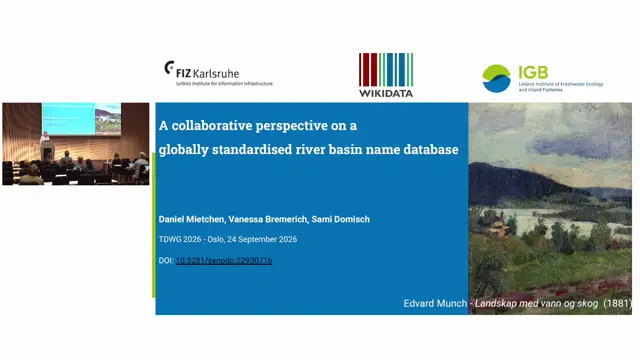
A collaborative perspective on a globally standardised river basin name database
Freshwater biodiversity data need a global, multilingual, collaboratively maintained river basin naming system, and TDWG, Wikidata and OpenStreetMap could build it together.
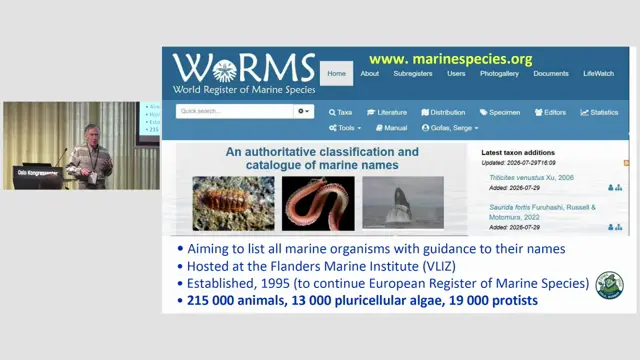
Mapping geographical distributions in the World Register of Marine Species
A country-aware, hierarchical marine geoscheme will let WoRMS and others record and query distributions consistently, pending a solution for defining spatial units in a TDWG standard.
Geonomia: Metadata and Community for Georeferencing
Clustering specimens into collecting trips makes georeferencing and AI enrichment more efficient and should be done as a community effort.