Summaries and key moments are machine-produced. Check the recording for the speaker’s exact words.
The short versionThe Darwin Core conceptual model and Data Package give material entities a rich, relational context that flat Darwin Core Archives could not express.
↶Go back to 2025Data Package pilot · 1 connection↓
Revisit Living Data 2025 alongside this talk. These connections were checked against captions; related examples may come from different teams rather than a direct follow-up.
Continuing work
The conceptual model, presented with a design tool
2025 Living Data
John Wieczorek describes the proposed conceptual model as a semantic layer for Darwin Core classes.
Darwin Core Data Package: A Practical Evolution to Support Richer, Deeper, and New Biodiversity Data Sharing
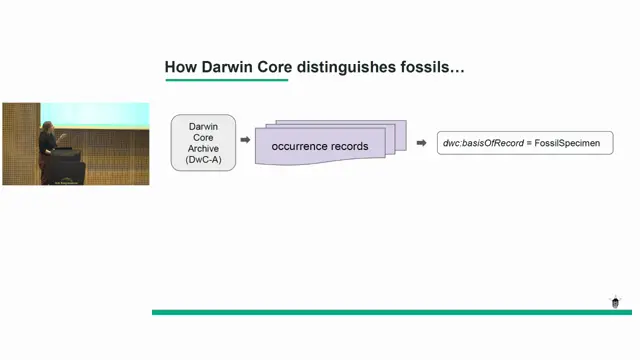
recognize the complete significance of is for the first time an attempt to make a conceptual model a semantic layer for Darwin core. So that's this document called the conceptual model. Uh, another part of the standard are the terms that I talked about and in this review we'll have new terms that are needed in order to support the use cases that are covered by the Darwin core data package and we'll have changes proposed to some existing terms to make things more clear based on the semantics that we're trying to implement here and uh and the structure that we're we're adding. Hold on there. So this slide adds a document, a
2026 This talk
John demonstrates the Data Package Designer and generating a descriptor from selected tables.
From Specimens to Networks: Darwin Core Data Packages in Practice
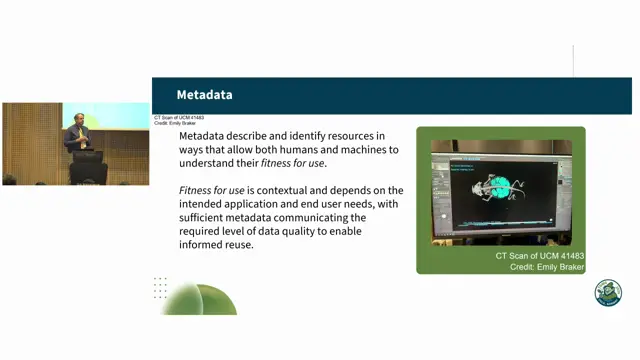
that the data package and the conceptual model allow you. Here, I'm switching to just quickly introduce in three slides a tool that will help you to understand and play with the Darwin Core data package in function of what it is that you think you have. So I've got some check marks over there about three tables that I know I'm going to need. I know I'm going to need an event, an identification, and material. I actually chose some more of these, and then I have the option to look at that in a network model. So this is some other slide that I gave you earlier, given to you, built for you through this tool, the Darwin Core Data Package Designer, and it shows all the relationships, and things are clickable. You can find definitions. You can understand what evidence for means. It's defined, et cetera, in this tool. And then finally, once you think you've got everything you need selected, then it can generate for you a data package .JSON file, which describes what you expect to be in your CSV tables when you build the package that you're going to send
The same speaker and standard connect a conceptual explanation with a concrete authoring demonstration in the later talk.
About this connection
Tools already existed in 2025. This pair does not establish when the Designer was first built, or that authoring tools were absent before 2026.
This pilot covers one 2025 symposium and selected 2026 moments. Automatic captions can contain mistakes; audio has not been checked.
Overview
What this was about
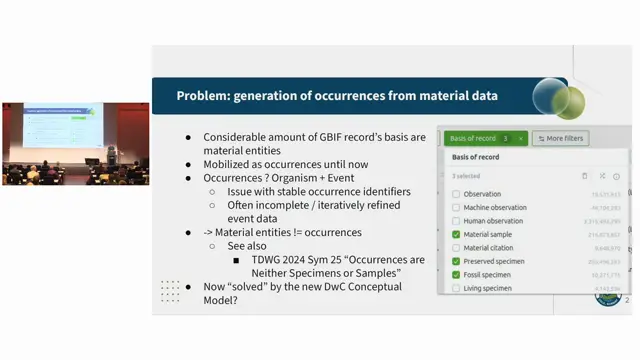
John Wieczorek explained that Darwin Core has moved from a 'bag of terms' to a standard with a conceptual model defining relationships between classes, focusing on MaterialEntity. Material entities can be part of or derived from other material entities. They take part in collection, sampling and derivation events, serve as evidence for occurrences and identifications, and connect to geological context and chronometric age. They can also underpin nucleotide analyses and sequences. Agents, media, assertions, identifiers, references, provenance, protocols and usage policies attach to classes via role and link tables. He closed by demonstrating the Darwin Core Data Package Designer, which generates a datapackage.json from selected tables.
Why it matters. It is the foundational explanation of DwC-DP semantics that several later talks in the session mapped against. The Designer tool offers a practical starting point for mapping CMS data.
Key ideas
In the room
Darwin Core was a 'bag of terms'; the conceptual model now adds semantics at the level of classes as part of the standard.
MaterialEntity: identifiable, persists for some time, consists wholly or partly of physical matter (organism, part, non-biological material, environmental sample).
Two self-referential relationships: part of (physically connected) and derived from (no longer connected).
Material entities take part in collecting, sampling and derivation (lab) events, and are evidence for occurrences and identifications.
Geological context and chronometric age separate today's collecting event from the inferred past occurrence.
Molecular data: material (even used-up material) is the basis for nucleotide analyses and sequences.
Agents (people, institutions, software/AI) link via role tables; media link via material-media and event-media tables; assertions generalise measurements or facts.
Jump in
Notable moments
In their words
Transcript
Automatically generated captions can contain mistakes, especially in names and technical terms. Times are relative to the room recording.