Summaries and key moments are machine-produced. Check the recording for the speaker’s exact words.
The short versionDINA's material-sample model maps well to DwC-DP, so DINA wants to publish without synthetic occurrences and needs community conventions for consumers to derive them.
↶Go back to 2025Data Package pilot · 2 connections↓
Revisit Living Data 2025 alongside this talk. These connections were checked against captions; related examples may come from different teams rather than a direct follow-up.
Part 1 Q&A: effort, identifiers, complexity for users, Indigenous data, interactions, EML and extended specimens
this easier for people um because it's going to be hard and I would expect tool developers such as the IP for example to have to help people manage these things. I would also expect it that to be the case that some of the identifiers will be unique and persist across time while others might be only uh valid within the Darwin core data package as it's being created. So we'll have certain things like specimen ids which are probably stable across long periods of time but there could be others that uh really only need to exist within that version of a data set. And I think we'll probably end up in the situation that we've got two classes of identifiers. Some that you can rely on and others that are really just joining data within one data set. >> Matt asks that we introduce ourselves. >> I'm sorry. I was asked to introduce myself. I'm Tim Robertson. I'm deputy director and head of informatics at GBish.
2026 This talk
Jonas Grieb explains that material records are not occurrences and raises stable-ID and missing-event problems when material data is mobilised as occurrences.
Material Samples and Occurrences in Darwin Core Data Packages: Practical Experiences from DINA
And yeah, when we just have originally material data that needs to be mobilized as occurrences, this creates issues with the generation of, in theory, stable occurrence identifiers, and often in the material data, we have incomplete or missing event data, but the event in theory is missing to establish an occurrence. So it is clear material entities are not occurrences. This has also been widely discussed in this community before, for example, at the TWIC 2024. And the question I'm asking today is whether these conceptual issues have now been solved by the Darwin Core conceptual model and the data package format from a practical perspective. Specifically, we want to look at this set of classes or tables in Darwin Core data packages, very similar to the graphic you've also seen before. The great news is really for data publishers with material data that we now have a specific point where we can put the data in the material. But also you can see that there's quite a set of complex relationships and we want to explore the practicability of sharing data in this format from the point of view of, for example, Natural History Museum, which has material data in a collection management system.
The later case makes identifier stability concrete in publication from a collection-management system.
About this connection
These are related identifier problems, not proof that DINA is a direct follow-up to the 2025 discussion; local join keys and global identifiers must remain distinct.
Related example
Material derivation across two collection examples
2025 Living Data
Jörg Holetschek shows the Berlin herbarium’s specimens, tissues and DNA samples as linked materials rather than disconnected exports.
From Flat to Structured: Enhancing Natural History Collection Datasets in GBIF Using Darwin Core Data Packages
Um so far so before Darwin core data package we provided only the specimen and the specimen image to GIF um the tissue and the material samples we shared with the global genome biodiversity network because um this network also is able to um to show all the associations between the objects. So you can if you're looking for a DNA sample, you can go to GGBN, it'll find the DNA sample and then it will link you to the um tissue sample this DNA has been taken from and then to the specimen that the tissue has been taken from and as I said before the sequences are shared with NCBI. Um now again publishing model as Gary showed. Um again of course uh a specimen documents the existing the existence of an organism um the an event documents the gathering event documents the existence of an occurrence um at a given location of course. And then all the materials that get um that get um sampled or that get gathered of course first is the specimen that is the specimen gathered on site. Uh later the material is taken the material sample the tissue sample is taken from the specimen and the DNA is uh taken from from the tissue sample. Um these are the the arrows. They show that um this this this
2026 This talk
Jonas Grieb works through a bat specimen, tissue and molecular-extract chain using material derivation relationships.
Material Samples and Occurrences in Darwin Core Data Packages: Practical Experiences from DINA
Now I want to show you two very practical examples of data. How is it in Dino, and how can it be transformed into something in the Darwin Core data package format? This first example that you see here is a material sample, which represent actually a molecular sample that was extracted from something. So it has a parent material sample, a tissue sample preserved in alcohol, which in turn also has a parent material sample, which is a cataloged specimen of a fruit bat in a mammalogy collection. Now, what you see on this slide is really the same information as on the previous slide, but according to DINA's internal database schema, that's the upper and the left part of the slide. You will see again three blue boxes. They represent three material samples. They have a relationship between them via the parent material sample field, and we also have an organism with a determination in the scientific name. On the right lower part, you see how this data would be transformed in Darwin Core data package. And it works very well. Material samples just become material entities. We can model the relationships between them via the derived from material entity field. And that works very well. It just imposed some minor questions. For example, is it sufficient, like I did here, to link only the parent material sample of such a chain to the event where it was collected?
Two institutions illustrate how the same modelling capability can express specimen-to-sample lineage.
About this connection
This is a topical comparison of different datasets, not a demonstrated historical follow-up or evidence that DINA reused Berlin’s mapping.
This pilot covers one 2025 symposium and selected 2026 moments. Automatic captions can contain mistakes; audio has not been checked.
Overview
What this was about
Jonas Grieb asked whether the Darwin Core conceptual model and DwC-DP fix a long-standing problem: CMSs that only hold material and event data have had to invent occurrences to publish to GBIF, producing unstable occurrence IDs. The DINA data model represents material object histories as material samples linked by processes and to collecting events, with organisms carrying determinations. Two worked examples showed good fit. A bat specimen, tissue and molecular extract chain maps to derivedFrom relationships. A mud shrimp and clam preserved together map to partOf relationships, though organism sex and life stage have no place on Material without creating an Occurrence. DINA therefore aims to publish DwC-DP without occurrences and let consumers such as GBIF derive them, which needs agreed conventions.
Why it matters. It tests in practice whether DwC-DP ends the 'material entities are not occurrences' problem, and pinpoints the remaining gap (sex and life stage on material) and a governance question for GBIF.
Key ideas
In the room
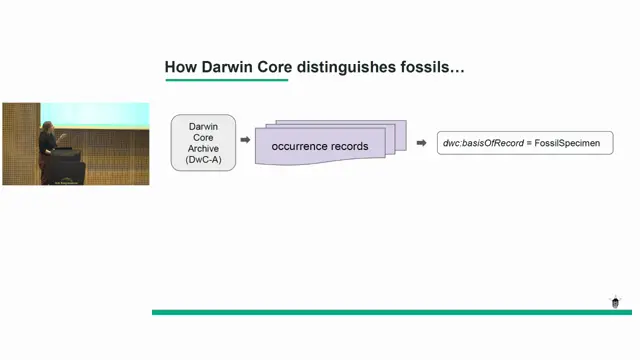
A large share of GBIF records have material-entity bases of record (preserved, fossil specimens, material samples).
Generating occurrences from material data causes unstable identifiers and incomplete events.
DINA (consortium since 2014, governed by an MOU) models material samples, processes (collecting, subsampling, extraction) and organisms with determinations.
Derivation chains map cleanly to MaterialEntity with derivedFromMaterialEntity; open question whether only the parent needs an event link.
Mixed-organism samples map to partOf relationships, with some semantic blurriness.
Sex and life stage cannot be placed on Material; options are a synthetic Occurrence (not favoured), non-schema fields, or Material Assertions (discoverability concerns).
DINA plans to publish DwC-DP without occurrences.
Jump in
Notable moments
In their words
Transcript
Automatically generated captions can contain mistakes, especially in names and technical terms. Times are relative to the room recording.