
AI-assisted digitisation of printed identification keys: from book to structured data in minutes
Wouter Koch · AI for Biodiversity Data
Summaries and key moments are machine-produced. Check the recording for the speaker’s exact words.
The short versionAn agentic LLM pipeline can turn printed keys and descriptions into a structured draft identification key for tens of dollars, shifting experts from transcribers to reviewers.
What this was about
Wouter Koch explained why identification keys remain essential alongside image recognition (pictures often lack diagnostic characters, models do not explain why, and training needs labelled data) and showed combining image-recognition top-5 suggestions with digital keys to ask only the discriminating questions. He then described an LLM agent pipeline, demonstrated on a new key to Norwegian rodents compiled from six books none of which alone covered all species: local OCR, one agent per source extracting modular, precise statements (using both keys, descriptions and images), a fresh audit agent with 'nothing to defend', merging and harmonising characters (with documented decisions and moving shared traits to higher taxa, optional translation), and a grounding agent verifying every statement against the sources. A single key costs about $10 in an hour, six books under about $30, producing a draft for expert review rather than a finished key; generated illustrations still fail.
Why it matters. Identification knowledge underpins observational data; cheaply mobilising keys from books improves accessibility, education and data quality.
In the room
- Keys embed domain knowledge that image classifiers cannot provide.
- Digital (multi-access) keys remove the linear dead-end problem of printed keys.
- Image recognition can filter a key to the characters separating its top candidates.
- OCR should be done locally and once, for cost and environmental reasons.
- Compound statements (e.g. 'brown fur, white legs, short tail') are split; vague terms are replaced by measurements from the text.
- A fresh audit agent works better than having the original agent correct its own work.
- Merging treats indistinguishable descriptions (pale yellow vs whitish yellow) as the same and documents every such decision.
Notable moments
Transcript
Automatically generated captions can contain mistakes, especially in names and technical terms. Times are relative to the room recording.
Read the transcript ↓
Related talks.
Structured identification keys complementing AI: closing the corpus bottleneck with AI-assisted digitisation
AI and identification keys are complementary, and LLM-assisted digitisation of printed literature now makes it feasible to build structured keys at scale for expert review.
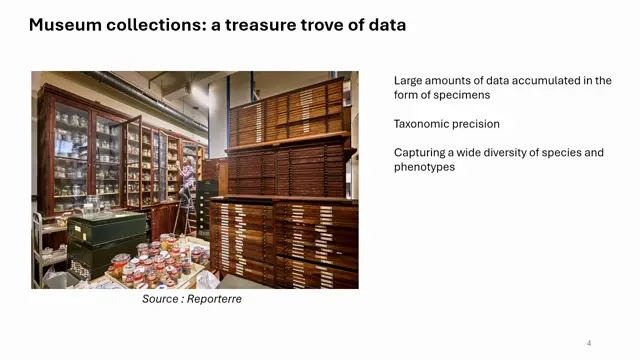
Beyond traditional identification keys: hybrid deep learning and Xper3 keys for insect identification
Deep-learning pre-filtering of an interactive key keeps the key's explainability while greatly shortening identification paths.
Introduction to the AI for Biodiversity Data session: what machine learning and LLMs actually do
LLMs are word predictors with no notion of truth, so their outputs, including hallucinations, cannot be objectively scored from the text alone.