
Ctrl+Alt+SDD: A Historical Review Toward a Standard Reboot
Elie Saliba, Adeline Kerner · May the Data Be Structured: Linking Descriptions, Identification and AI
Summaries and key moments are machine-produced. Check the recording for the speaker’s exact words.
The short versionSDD is well-documented but dormant and imperfectly interoperable, and the Xper4 rebuild is an opportunity to reopen and modernise it together with the community.
What this was about
A two-part review of TDWG's Structured Descriptive Data (SDD) standard. Elie Saliba traced its lineage from single-access keys and the DELTA format through SDD's development (from 1998, ratified 2005, last updated to 1.1 in 2006-2007) and noted that much of its development record was lost when a wiki disappeared. Adeline Kerner then showed how the Xper software family has implemented SDD and where it has had to bend or extend it, and suggested that the Xper4 redevelopment is a chance to restart community discussion on SDD.
Why it matters. Structured descriptive data underpin interactive identification keys, and several later talks in the session (Xper-AI hybrids, recording identification sessions) depend on SDD being revived and extended. The talk also warns about how easily standards history can be lost.
In the room
- Single-access keys (the oldest attributed to Lamarck, 1815) make it hard to express doubt or go back, and get stuck when a character is not visible; free-access keys need formalised descriptions but allow multiple paths, weighting and extra help.
- DELTA (Description Language for Taxonomy), developed and maintained by Mike Dallwitz in Australia since the 1970s and endorsed by TDWG in the 1980s, was tied to its own software, so other tools created their own formats; SDD was introduced to restore interoperability.
- SDD discussions began at the 1998 meeting, driven by Gregor Hagedorn (who wrote a PhD largely on the topic); SDD 1.0 was approved in 2005 at St Petersburg and SDD 1.1 (2006-2007, prompted by GBIF) was the last public update. It was used in European projects such as EDIT.
- Most development documentation lived on a wiki that was lost; the history had to be rebuilt from printed personal archives, and the TDWG GitHub copy needs curation.
- SDD has five main classes (described entities/items, descriptors, states, descriptions, groups) and is XML-based. Its flexibility undermined interoperability, it has no provision for AI, captures little metadata and does not store user identification paths.
- Xper has evolved from a 1980s standalone program through Xper2 to the free, collaborative, online Xper3, keeping SDD import/export throughout. The Xper3 identification web services consume SDD.
- Lucid and Xper both implemented SDD, but a 2008 comparison found their files were not fully interoperable, because of how the XML was structured rather than because of the tags.
Notable moments
Transcript
Automatically generated captions can contain mistakes, especially in names and technical terms. Times are relative to the room recording.
Read the transcript ↓
Related talks.
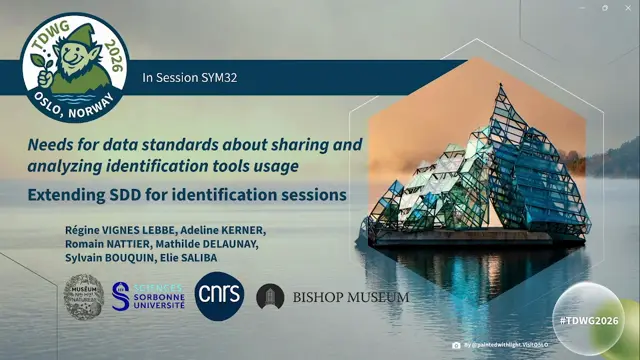
Needs for data standards about sharing and analyzing identification tools usage
SDD should be extended so identification sessions (context, uncertain responses, backtracking and AI outputs) become open, shareable data, not just the keys.
An Introduction to the Biodiversity Data Quality Standard (BDQ)
BDQ provides 110 standard, use-case-linked tests so that data quality can be assessed consistently from collection to aggregation.
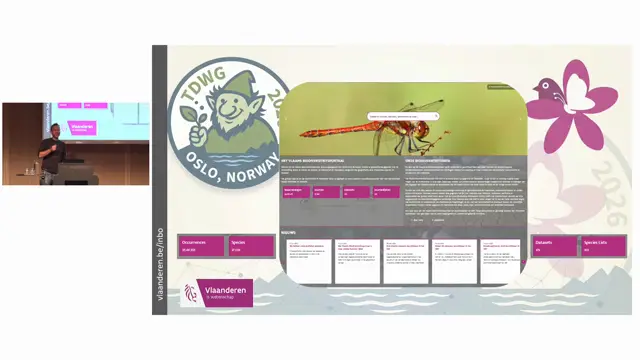
Role-Based Access Control (RBAC) for RASD: The Flemish Biodiversity Portal Approach
The Flemish portal implements restricted access through role-based access control, with institutions rather than the portal team deciding who may see high-resolution data.