
kabr-tools: A Modular Workflow for Automated Video-Based Behavioral Monitoring Across the Autonomy Spectrum
Jenna Kline · Bots, Bits, and Biodiversity
Summaries and key moments are machine-produced. Check the recording for the speaker’s exact words.
The short versionkabr-tools offers a modular, model-agnostic pipeline from drone or camera-trap video to ecological behaviour analysis.
What this was about
In a pre-recorded lightning talk, Jenna Kline introduced kabr-tools, which grew out of the KABR (Kenyan Animal Behavior Recognition) drone video dataset collected at Mpala Research Centre in 2023 (about 10 hours of footage, 900+ annotated videos, ~200,000 Hugging Face downloads). The modular workflow runs from drone or camera-trap video collection through model-agnostic detection, tracking and behaviour annotation with manual oversight, to ecological analyses such as time budgets, behaviour transitions and individual behaviour patterns, and has been used for African wild dog studies.
Why it matters. Helps ecologists process video datasets too large for manual analysis while choosing their level of automation.
In the room
- KABR dataset: three species, about 10 hours of footage, over 900 annotated behaviour videos, about 200,000 downloads on Hugging Face.
- Workflow stages: detection, tracking and behaviour annotation, all model-agnostic with adjustable autonomy.
- Supports time budgets, behaviour transitions, land-use comparisons and individual identity tracking.
- Used by collaborators for camera trap and drone studies of African wild dogs; scripts, data and preprint available online.
Notable moments
Transcript
Automatically generated captions can contain mistakes, especially in names and technical terms. Times are relative to the room recording.
Read the transcript ↓
Related talks.
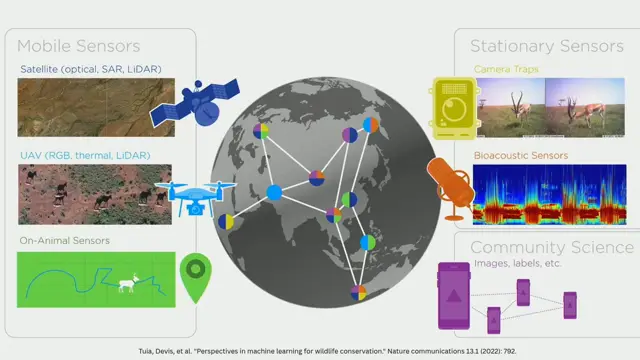
Cross-Modal Coordination for Biodiversity Monitoring at Scale: Lessons from SmartWilds
Coordinating multiple sensor modalities with AI at the far edge, informed by synchronised multimodal datasets like SmartWilds, can scale and adapt biodiversity monitoring.
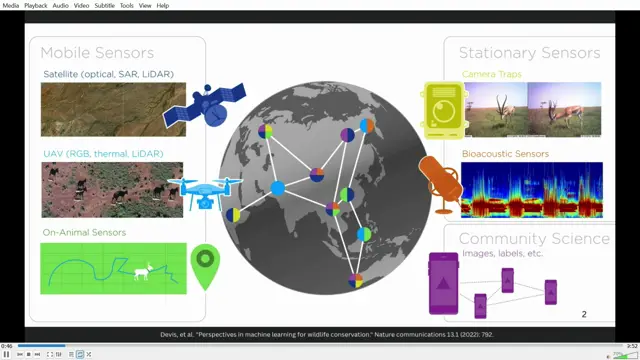
FAIR² Drones: An AI-Ready Standard for Cross-Domain Wildlife Drone Dataset
A shared dataset card that captures ecological, robotic and computer vision metadata makes costly drone datasets reusable across disciplines.
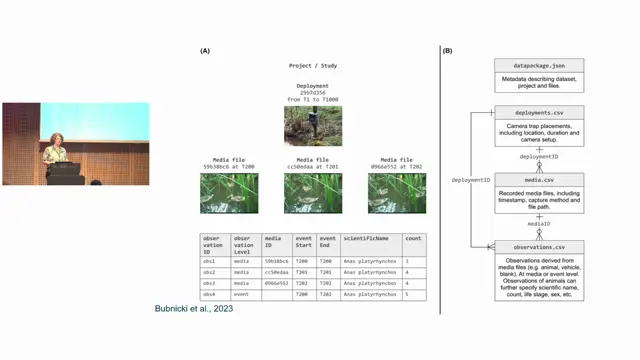
Camtrap DP: extending data standard designed for camera trapping research to support AI workflows and new data sources
Camtrap DP fits data from any stationary sensor, and converging community feedback shows how to extend it for AI provenance and multimodal monitoring.