
Everything is coded: How to prevent a game of telephone in a system full of interfaces
Franziska Schuster, Jasper · From Cabinets to Clouds - Bridging the gap between collection- and database management
Summaries and key moments are machine-produced. Check the recording for the speaker’s exact words.
The short versionShared understanding of what data means must be established at the start of a pipeline; standard formats alone won't stop meaning drifting between people.
What this was about
Franziska Schuster framed MfN's digital catalogue infrastructure work through the 'game of telephone': standard formats like Darwin Core alone don't keep data meaning intact across professional hand-offs. Developer Jasper then described migrating about 600,000 insect specimen records with 2.5 million images, digitised by a Picturae conveyor pipeline, into Specify after the cyber attack fragmented the data. Requirements unclear from the start made his mapping code slow and hard to verify. Taxon 'NURIs' (internal identifiers) turned out to be non-unique, with up to 2,000 IDs for one taxon, test entries and drawer IDs reused as taxon IDs. Schuster closed with Scrum as a 'don't panic' strategy with three-week sprints and stakeholder feedback.
Why it matters. It is a candid case study of how identifier semantics break down in mass digitisation pipelines, and it shows how agile methods can manage infrastructure rebuilds.
In the room
- Coded systems narrow meaning only if sender and receiver share an understanding of the code.
- The Picturae conveyor pipeline digitised just over 600,000 specimens with over 2.5 million images, about 5,000 specimens per day, over roughly 2.5 years including development.
- After the hack the data were fragmented; deduplication and consolidation came before mapping to Specify.
- Iterative feedback from Specify and collection managers made the mapping code increasingly slow and opaque; a month-long rewrite followed after publishing about 22,000 records.
- Taxon NURIs were not unique: up to 2,000 IDs per taxon, empty taxa with IDs, and test entries.
- Pragmatic fix: accept a taxon NURI only if unique; otherwise keep it in the determination for findability.
- Key missing question: is the data sufficient at this point to assign an identifier?
Notable moments
Transcript
Automatically generated captions can contain mistakes, especially in names and technical terms. Times are relative to the room recording.
Read the transcript ↓
Related talks.
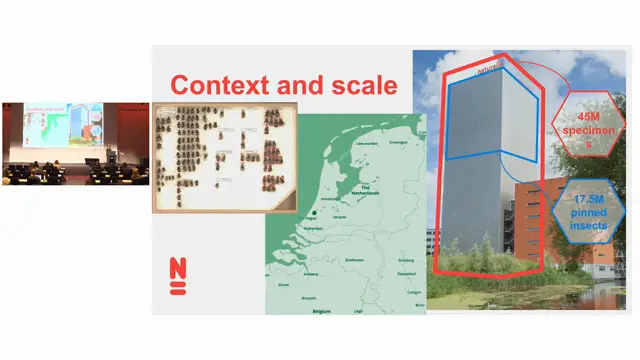
Managing high-volume specimen movements in the entomological collection of Naturalis with a new type of record
A 'lot' record linking taxa to storage units makes high-volume physical moves cheap to record and tells staff where each taxon is.
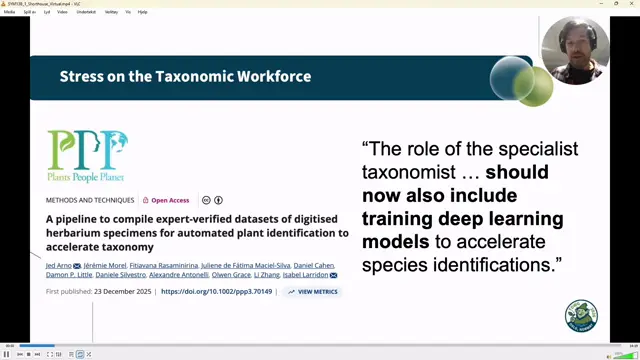
Open Digital Curation and Round-Tripping Biodiversity Data Enhancements Across Collection Infrastructures: Six Years and 50 Million Links in Bionomia
Round-tripping is much harder than expected, and data managers must fully populate identifiedBy so taxonomists' expertise is credited.
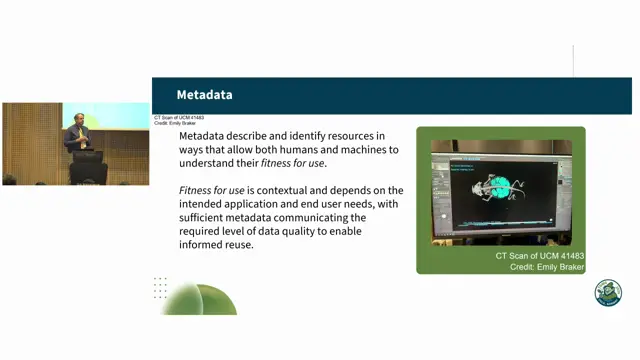
Metadata matters: perceptions on the implementation of Darwin Core in the biocollections cyberinfrastructure
Standardisation through Darwin Core can mask nuance, and practitioners report complex data, missing guidelines and limited capacity as the main implementation barriers.