
Are plant image datasets ready for AI-enabled community assessment? A systematic review of bias, representativeness and annotation quality
Yuchen Zhao · AI for Biodiversity Data
Summaries and key moments are machine-produced. Check the recording for the speaker’s exact words.
The short versionCurrent plant image datasets are not yet ready for AI-enabled ecological monitoring, especially for spatially explicit tasks and annotation quality.
What this was about
Yuchen Zhao (Newcastle University) argued that ecological AI is constrained less by model architecture than by the quantity and quality of training data. She presented a four-dimension framework, inspired by clinical reporting frameworks and FAIR, for assessing plant image dataset readiness: training-relevant characteristics, image acquisition characteristics, annotation protocol, and accessibility. A systematic review of in-situ, non-crop plant object detection and segmentation datasets screened 360 unique studies and found only 40 eligible datasets, with strong geographic bias toward Europe and Asia, a dominance of agricultural applications (19 of 40 focused on wheat), neglect of background plants, and generally unsatisfactory annotation protocols.
Why it matters. Spatially explicit tasks (locating plants and estimating cover) are needed for ecological inference, and the review offers a framework for building and reporting datasets fit for them.
In the room
- Imaging tasks: classification (present?), object detection (where?), segmentation (where exactly, and what cover?).
- Framework dimensions: training-relevant characteristics; acquisition (growth stage, season, angle, location, protocol, weather); annotation protocol and QC; accessibility.
- 508 records, 360 unique studies screened, 40 eligible datasets.
- Object detection datasets are increasing; segmentation less so; ground-level and UAV imagery dominate with growing use of consumer devices.
- Datasets are uneven in size and concentrated in Europe and Asia, neglecting biodiversity hotspots.
- Wheat (19/40) and tree crowns (8) dominate; only 3 on wildflowers.
Notable moments
Transcript
Automatically generated captions can contain mistakes, especially in names and technical terms. Times are relative to the room recording.
Read the transcript ↓
Related talks.

Scalable Edge AI for Real-Time Biodiversity Monitoring: tracking invasive plant species in roadside imagery
Distilling a tiling-based plant identifier into a single ConvNeXt model makes high-resolution roadside invasive-species monitoring fast, cheap and more accurate.
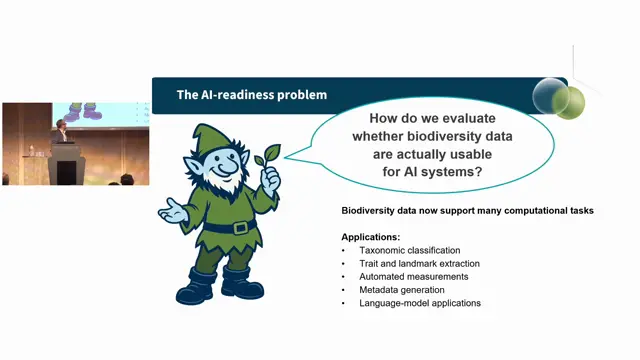
Toward Quantitative AI-Readiness Metrics for Biodiversity Data Infrastructures
AI readiness should be a task-specific, measurable profile rather than a single score, and current biodiversity standards lack most of the terms needed to describe it.

From Sensor to Species: AI-Assisted Segmentation, Deep Learning Workflows, and Persistent Biodiversity Records from Earth Observation Systems
Persistent organism identifiers for remotely sensed individual trees could turn repeat Earth-observation imagery into longitudinal biodiversity records, but only if uncertainty and model provenance travel with every record.