
Capitalizing the Invisible Ledger: A Cost-of-Production and Shadow Pricing Methodology for Valuing Open-Source Biodiversity Assets in India
Ashwin A · Community-Powered, Research-Ready: Citizen Science for a Digital Future
Summaries and key moments are machine-produced. Check the recording for the speaker’s exact words.
The short versionOpen access removes the price of biodiversity data, not its production cost; citizen science is under-recognised national data infrastructure.
What this was about
Ashwin A estimates the hidden production cost of India's roughly 2.8 million open-access citizen-science biodiversity observations, whose market price is zero. Building a cost model from field effort, taxonomic expertise, platform and data infrastructure and participant capital, he estimates about ₹137-676 per reusable occurrence record, compared with ₹700-3,500 for professional producers and ₹2,500-7,000 per institutional specimen output (not equivalent products). He argues open access removes the price of access, not the cost of production, and calls for recognising citizen science as productive data infrastructure and co-investing in validation and coverage.
Why it matters. Putting a shadow price on citizen-science records gives funders and policymakers an economic argument for investing in validation, coverage and platforms.
In the room
- The economic asset is a reusable, identified, standardized and interoperable occurrence record, distinct from a photo or voucher specimen.
- Cost components: core production (field effort ~₹104/hour, taxonomy expertise ~₹133/hour, platform ₹3-15/record), data infrastructure (+₹2-5/record), participant capital (₹80-160/record).
- Estimated total ₹137-676 per record versus ₹700-3,500 for professional/NGO production and ₹2,500-7,000 per institutional specimen output.
- Under-recognition leads to under-investment, spatial gaps, taxonomic biases and validation backlogs.
- Citizen science redistributes production costs across citizens, experts and infrastructure rather than eliminating them.
- Calls to standardize valuation and co-invest in platform, validation, coverage and capacity.
Notable moments
Transcript
Automatically generated captions can contain mistakes, especially in names and technical terms. Times are relative to the room recording.
Read the transcript ↓
Related talks.
Symposium discussion: funding models, open data and sustaining biodiversity infrastructure
The community broadly agreed that core data should stay open, but that products, services, credits, regulation and partnerships must become part of sustaining the infrastructure.
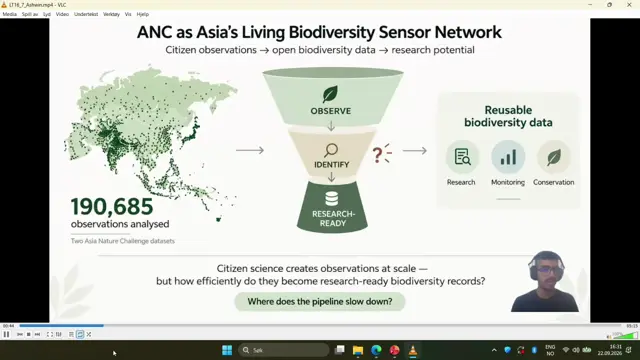
The Asian Nature Challenge as a Beacon of Citizen Science: Regional Contributions, Macroecological Data Networks, and Strategies for Optimizing Taxonomic Identification Efficiency in India
More observations do not mean more usable data; identification capacity is the bottleneck for India's citizen science.
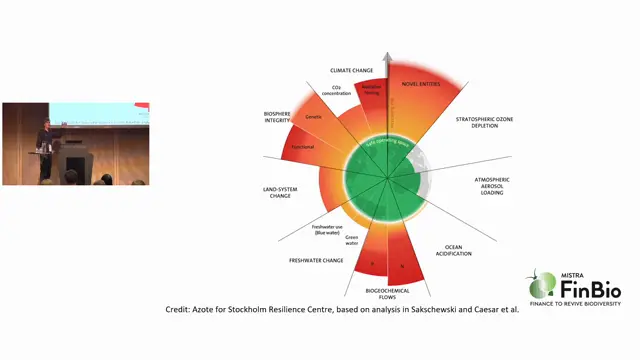
Data Quality in Focus: Bridging the Biodiversity Data Gap for Sustainable Finance
Biodiversity assessments for finance need local data; a tiered data-quality hierarchy like carbon accounting could make them credible.