
The Asian Nature Challenge as a Beacon of Citizen Science: Regional Contributions, Macroecological Data Networks, and Strategies for Optimizing Taxonomic Identification Efficiency in India
Ashwin A · Community-Powered, Research-Ready: Citizen Science for a Digital Future
Summaries and key moments are machine-produced. Check the recording for the speaker’s exact words.
The short versionMore observations do not mean more usable data; identification capacity is the bottleneck for India's citizen science.
What this was about
Ashwin A analyses two years (2024-2025) of the Asian Nature Challenge on iNaturalist, about 190,000 observations, asking how efficiently observations become research-ready. India contributed about 47,000 observations but only about 40% reached research grade, compared with 60-79% for other countries, revealing an identification deficit that is taxonomically graded: birds and mammals reach research grade easily while plants and fungi are around 4%, a 22-fold spread. He proposes an identification flywheel: target backlogs, build identifier networks, run targeted mobilisation such as identification-a-thons and use AI-assisted, human-verified identification.
Why it matters. It pinpoints where citizen-science pipelines stall and suggests targeted interventions to turn volume into research-ready records.
In the room
- Asian Nature Challenge aims to increase Asian representation on iNaturalist.
- ~190,000 observations in 2024-2025.
- Research grade is a community-supported ID used as a proxy for data readiness, not a guarantee of correctness.
- India: ~47,000 observations, ~40% research grade; other countries 60-79%.
- Identification bottleneck varies by taxon: birds/mammals high, plants and fungi ~4%; ~22-fold difference.
- Drivers: identifier capacity, photo-identifiability of taxa, and available evidence and digital support.
- Identification flywheel: more IDs → more accurate data → more training data → better IDs → more observers.
Notable moments
Transcript
Automatically generated captions can contain mistakes, especially in names and technical terms. Times are relative to the room recording.
Read the transcript ↓
Related talks.
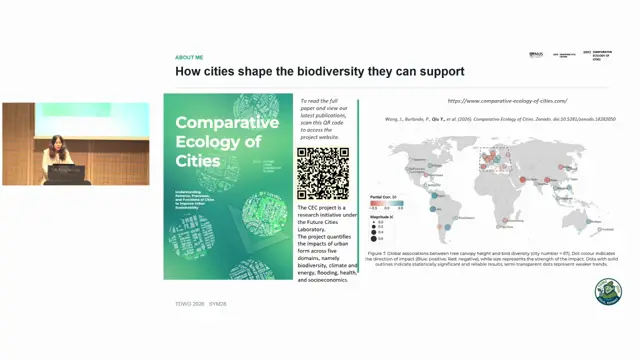
Reporting structure and sampling-bias correction in citizen-science bird data across Asian cities
Abundant citizen-science records do not guarantee inference support; reporting structure can distort richness hotspots and urban-biodiversity relationships unless it is diagnosed and controlled.
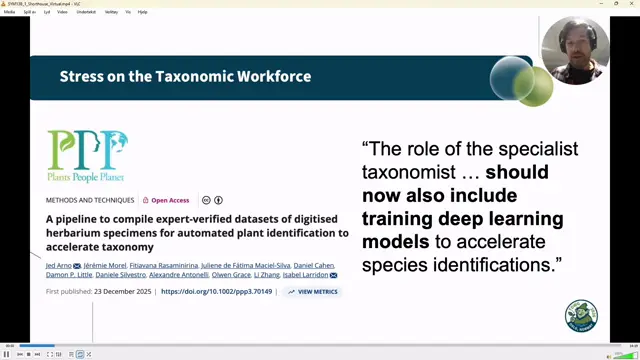
Open Digital Curation and Round-Tripping Biodiversity Data Enhancements Across Collection Infrastructures: Six Years and 50 Million Links in Bionomia
Round-tripping is much harder than expected, and data managers must fully populate identifiedBy so taxonomists' expertise is credited.
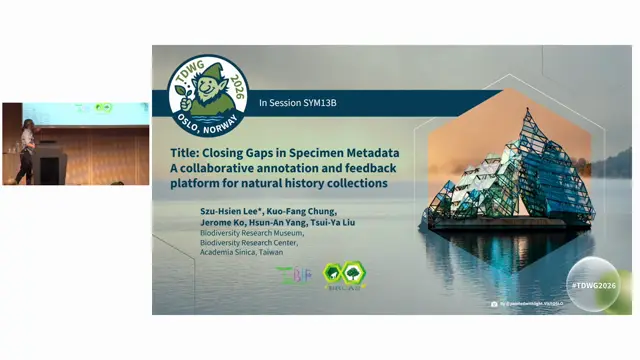
Closing Gaps in Specimen Metadata: A Collaborative Annotation and Feedback Platform for Natural History Collections
A national collaborative annotation platform with AI-assisted transcription can close metadata gaps across many Taiwanese collections.