
Rethinking “absence” in biodiversity data collection and modeling
Rob Stevenson · FAIR data in practice - eDNA, modelling and biodiversity concepts
Summaries and key moments are machine-produced. Check the recording for the speaker’s exact words.
The short versionSeparating observation from inference means recording 'detected' and 'not detected' rather than presence and absence.
What this was about
Rob Stevenson presented the outcome of a working group (with Abby Benson, Ruben Perez, Deborah Arlt, Yiming and Wesley Hochachka) on confusing 'absence' terminology. He argued presence and absence are asymmetric (presence is a fact, absence a question) and absence is only meaningful against an expectation frame such as a Humboldt Extension survey target. Surveying methodology and analysis texts, the group found the museum (presence-only) and biological survey (repeated, effort-based) communities use different data and models, with detectability as the unifying concept. The main outcome was the TDWG Executive's approval in May of changing Darwin Core occurrenceStatus values from present/absent to detected/not detected.
Why it matters. The occurrenceStatus vocabulary change affects how every data manager records and interprets non-detections, and clarifies terminology for distribution modelling.
In the room
- Many overlapping absence terms exist in the literature (confirmed absence, zero count, pseudo-absence, etc.).
- Presence and absence are asymmetric: presence is a fact, absence is a question.
- Absence is meaningful only against a model of what should have been present; survey targets in the Humboldt Extension provide that frame.
- Survey methodology books rarely define absence terms in data-sharing terms; Hill et al.'s handbook was most useful.
- Museum data (presence-only, Bioclim/GARP/MaxEnt niche models) and survey data (repeated surveys, occupancy and hierarchical models) come from different communities.
- Detectability, from mark-recapture, distance sampling and occupancy models, is the key clarifying concept.
- Darwin Core occurrenceStatus changed from present/absent to detected/not detected.
Notable moments
Transcript
Automatically generated captions can contain mistakes, especially in names and technical terms. Times are relative to the room recording.
Read the transcript ↓
Related talks.
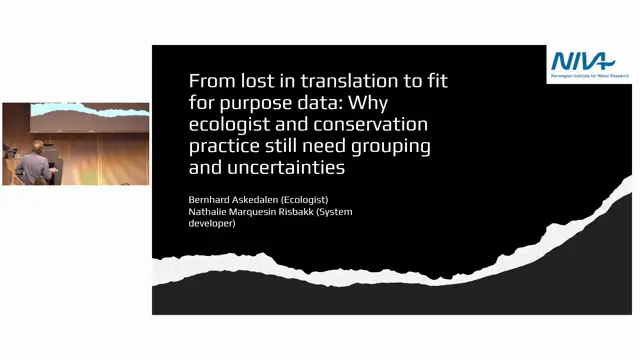
From 'Lost in Translation' to Fit-for-Purpose Data: Why Ecologists and Conservation Practice Still Need Groupings and Uncertainties
Biodiversity data systems must be able to record identification uncertainty and taxonomic groupings, or ecologists face a choice between false certainty and lost ecological information.
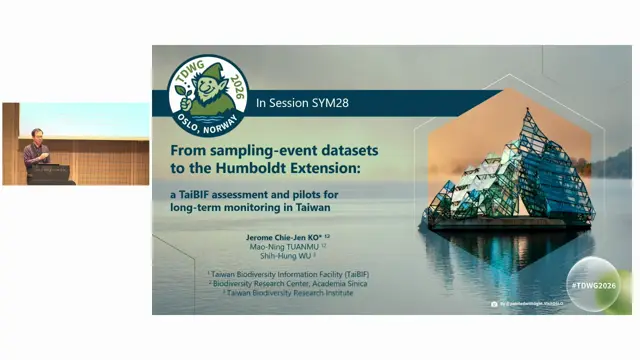
From sampling-event datasets to the Humboldt Extension: a TaiBIF assessment and pilots for long-term monitoring in Taiwan
Giving monitoring-data providers immediate site-level trend feedback, based on a minimal set of Humboldt terms, can motivate adoption better than asking for the full extension.
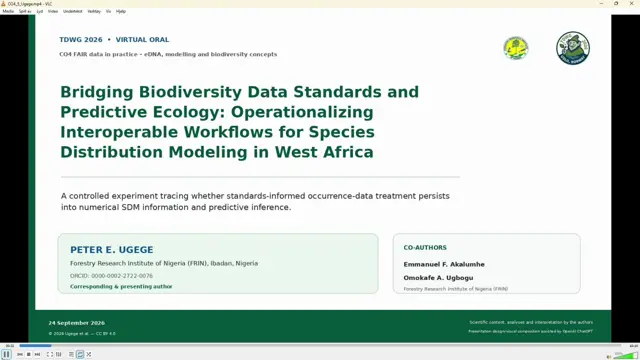
Bridging Biodiversity Data Standards and Predictive Ecology: Operationalizing Interoperable Workflows for Species Distribution Modeling in West Africa
Standards change what enters a modelling pipeline, but workflow design determines whether that difference survives and validation design determines what claims can be made.