
NEON, Community Standards, and the Hyper-Extended Specimen
Chandra Earl · Sustaining the Geo- and Biodiversity Data Ecosystem: Standards-Driven Approaches to Long-Term Resilience
Summaries and key moments are machine-produced. Check the recording for the speaker’s exact words.
The short versionNEON was built for interoperability from the start, but sustaining standards, crosswalks and value-added links needs community-level solutions.
What this was about
Chandra Earl presented NEON's design for resilient, interoperable data and samples: 81 sites across 20 ecoclimatic domains, over 400 TB of data a year, and about 100,000 samples a year curated at the NEON Biorepository. She described provenance tracking, issue management, modular pipelines, digital-born sample data, DOIs/IGSNs and external audits, and showed small-mammal vouchers as a 'hyper-extended specimen' linking occurrences, images, tissues, traits, molecular and pathogen data. She closed with questions about citation and impact tracing, who sustains standards and crosswalks, getting commercial users to contribute, and round-tripping of value-added data.
Why it matters. NEON is a large, standards-aligned observatory whose hyper-extended specimens show both the power and the complexity of linked data, and its open questions set up the session discussion.
In the room
- NEON is an NSF-funded, Battelle-operated observatory with 81 sites in 20 ecoclimatic domains, a planned 30-year lifespan and about seven years in.
- It combines automated sensors, airborne remote sensing and observational sampling: over 400 TB a year, 650 million sensor readings a day and 2.5 PB stored.
- Around 100,000 samples of about 65 types are archived yearly, representing over 8,000 taxa, mostly at the NEON Biorepository at Arizona State University.
- Sample data are born digital (barcodes replaced handwritten labels) and accessioned samples receive DOIs for use tracking.
- Data are audited for quality (Bob Mesibov) and AI readiness (ESIP).
- NEON uses EML, Darwin Core, MIxS, ENVO, USA-NPN phenophases, IGSNs, dataset DOIs, ORCIDs and RORs, and is testing the Humboldt Extension and Darwin Core Data Package with GBIF.
- NEON data are used beyond ecology: food security, drinking water safety after Hurricane Maria, permafrost pathogen sequencing and AI benchmark datasets.
Notable moments
Transcript
Automatically generated captions can contain mistakes, especially in names and technical terms. Times are relative to the room recording.
Read the transcript ↓
Related talks.
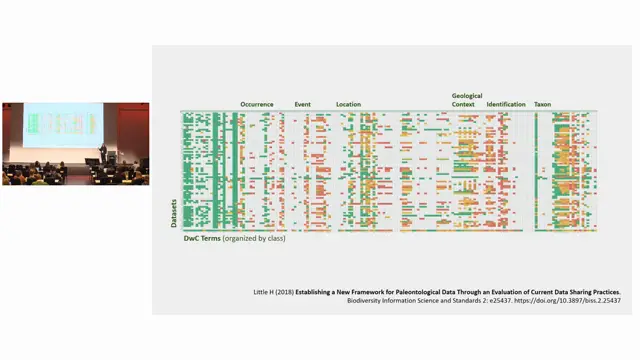
A framework for aligning collections data with the global data ecosystem from data creation to extension in the Smithsonian National Museum of Natural History Department of Paleobiology
Making paleo collections work in the global data ecosystem needs an iterative, full life-cycle framework, not one-off digitisation.
Confronting legacy data for primary type specimens
Decades of database migrations left the second-largest insect collection's type catalogue unreliable, and only a full physical inventory is fixing it.
Sharing Extended Specimen Data from Symbiota Portals using Registered Extensions
Existing registered Darwin Core extensions met each of Symbiota's extended-specimen needs, so look for existing standards before inventing new ones.