
Requirements of Sustainability Models for Geo-Biodiversity Data Cyberinfrastructure
José Fortes · Sustaining the Geo- and Biodiversity Data Ecosystem: Standards-Driven Approaches to Long-Term Resilience
Summaries and key moments are machine-produced. Check the recording for the speaker’s exact words.
The short versionCyberinfrastructure sustainability and ecosystem sustainability go hand in hand, so infrastructure must be designed from the start to track use and support economic orchestration.
What this was about
José Fortes asked how cyberinfrastructure design changes when sustainability is a first-order requirement, using music streaming (radio to Spotify) as an ecosystem in which aggregators and distributors route revenue back to content creators. He argued that biodiversity funding will become a hybrid of central grants, subscriptions, pay-as-you-go and partnerships, while stressing he supports open, free data for science. Because every model requires reporting use, cyberinfrastructure must add 'economic orchestration' (tracking who uses what, charging and distributing revenue), which needs community standards; ChatBio's usage tracking was offered as an early example.
Why it matters. It reframes sustainability as a design requirement for infrastructure and raises open questions about what the community would charge for and how revenue could reach small providers.
In the room
- Sustaining infrastructure is only possible if the ecosystem of providers and users is sustainable, and vice versa.
- Funding is shifting from funders distinct from users towards hybrids including subscriptions, advertising, pay-as-you-go and industry partnerships.
- All models require reporting of use, so infrastructure must track use of data and services and how revenue is distributed.
- Beyond technical orchestration, cyberinfrastructure needs an economic orchestration component; TDWG-style standards would be needed for it.
- Open questions include what to charge for: records, images, bytes or services.
- Small providers cannot build this themselves and need ways to interface with the ecosystem.
- ChatBio uses agents to access multiple resources and tracks which data sources were used, by whom, per session.
Notable moments
Transcript
Automatically generated captions can contain mistakes, especially in names and technical terms. Times are relative to the room recording.
Read the transcript ↓
Related talks.

Symposium discussion: funding models, open data and sustaining biodiversity infrastructure
The community broadly agreed that core data should stay open, but that products, services, credits, regulation and partnerships must become part of sustaining the infrastructure.
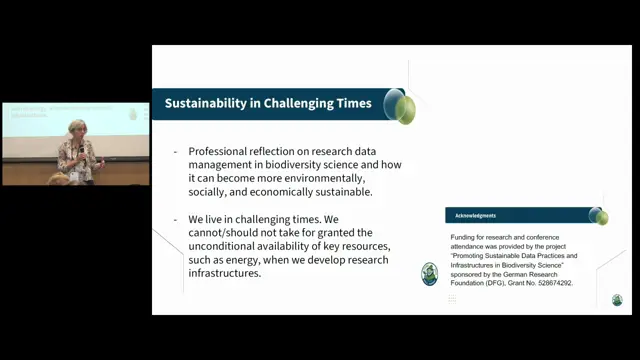
Adopting Environmental Sustainability as a Strategy to Build Resilient Data Infrastructures in Biodiversity Science
Building frugal, environmentally sustainable data infrastructures is a practical risk-management strategy for resilience.
SYM18 discussion: who sustains biodiversity data infrastructures?
Volunteer and single-developer infrastructures deliver proven value, but the community lacks mechanisms and funding to protect them.