
GBIF after 25 years
Joe Miller · Sustaining the Geo- and Biodiversity Data Ecosystem: Standards-Driven Approaches to Long-Term Resilience
Summaries and key moments are machine-produced. Check the recording for the speaker’s exact words.
The short versionGBIF sustains itself by leveraging stable national contributions into additional funding and by embedding itself in the biodiversity policy and funding architecture.
What this was about
Joe Miller explained how the GBIF Secretariat approaches sustainability: stable GDP-based national contributions from about 40 member countries, leveraged with European Commission grants, foundations and special funds so the budget has doubled in five years. He described DOI-based citation tracking showing data reuse in science and policy, and how about a quarter of the budget flows back out through BID and CESP programmes. He emphasised aligning with policy and funding mechanisms such as the CBD, GEF 9 and the Global Biodiversity Framework Fund, and previewed a pilot indexing South African data with the national taxonomy.
Why it matters. It offers a concrete, working model of how a global biodiversity infrastructure demonstrates value and secures long-term funding, including the policy links now being built with CBD and GEF.
In the room
- GBIF is an intergovernmental organisation in its 25th year, with around 40 member countries paying annually.
- DOIs on downloads allow tracking of data use; about eight peer-reviewed publications per day use GBIF-mediated data.
- 31 of 32 key messages of the 2023 IPBES invasive alien species assessment drew on literature using GBIF-mediated data.
- Contributions are GDP-based under a five-year MoU; leveraging this stability, the overall budget has doubled, giving roughly two euros of work programme per euro contributed.
- About 25% of the budget goes out to BID, CESP projects and contractors around the world.
- GBIF is working with the CBD, GEF, World Bank and UNDP; the CBD Executive Secretary encouraged all parties to join GBIF.
- Two thirds of seventh national reports to the CBD mention GBIF, but there are disconnects between national focal points.
Notable moments
Transcript
Automatically generated captions can contain mistakes, especially in names and technical terms. Times are relative to the room recording.
Read the transcript ↓
Related talks.
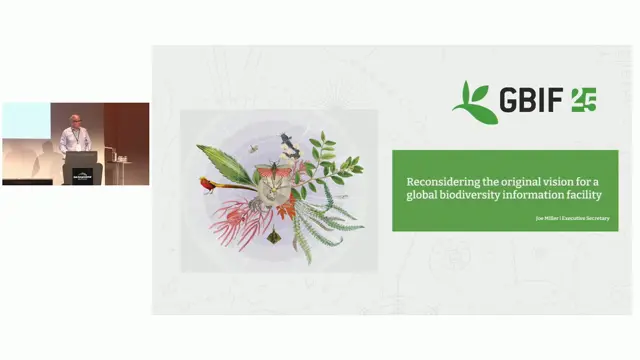
Reconsidering the original vision for a global biodiversity information facility
GBIF achieved its 1999 vision only partially and through a network of collaborating infrastructures; the community must decide whether that is enough and articulate the next vision.
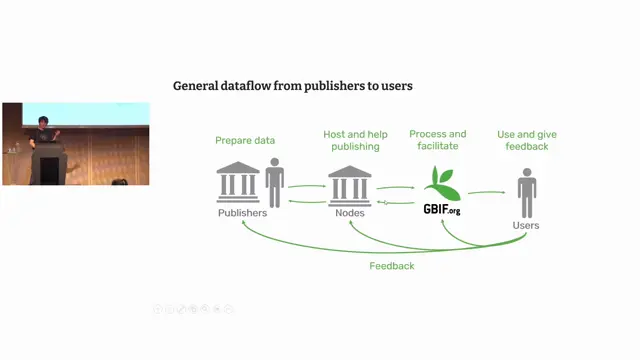
Digital curation across the biodiversity data lifecycle, at the node level (SiB Colombia), aggregator level (GBIF) and how to incorporate user feedback
Curation feedback works at every stage of the data lifecycle, and about a third or more of reported issues do get fixed; AI is used cautiously to summarise feedback.
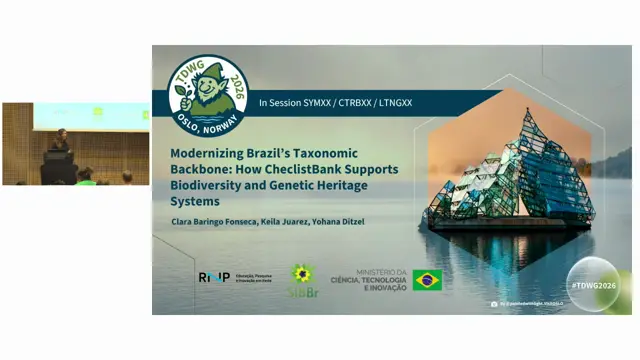
Modernizing Brazil's taxonomic backbone: how ChecklistBank supports biodiversity and genetic heritage systems
ChecklistBank lets a small national node assemble one consistent taxonomic backbone for legal, portal and permitting systems.