
ASEAN Biodiversity Dashboard as a data sharing platform to monitor biodiversity trends and species occurrences in the ASEAN Region
Christian Elloran · From Standards to Implementation: Connecting Observation Data in Asia to GBIF Infrastructure
Summaries and key moments are machine-produced. Check the recording for the speaker’s exact words.
The short versionInteroperable, GBIF-hosted regional infrastructure lets ACB turn occurrence data into indicators and dashboards for ASEAN policy reporting.
What this was about
Christian Elloran presented the ASEAN Biodiversity Dashboard, a GBIF-hosted portal maintained by the ASEAN Centre for Biodiversity (ACB) that combines species occurrences with protected areas, ASEAN Heritage Parks, habitat and land-cover change and carbon data. He described ACB's mandate across 11 member states, its infrastructure (own servers hosting an IPT and the dashboard; publishing to GBIF and OBIS) and a value chain from mobilisation and Darwin Core standardisation through integration, analysis (species distribution models, trends, gaps, indicators) to visualisation for KMGBF reporting and conservation planning. Customised dashboards are generated for member states' country reports; over 80% of data are birds.
Why it matters. It shows how a regional intergovernmental body uses GBIF infrastructure to link data mobilisation directly to CBD/KMGBF reporting and protected-area management in a highly biodiverse region.
In the room
- ACB was established in 2005 by ASEAN member states; Timor-Leste joined in October 2025, making 11 members.
- Challenge in ASEAN is not lack of data but making dispersed data discoverable, interoperable and reusable.
- ACB runs its own servers hosting an IPT and the dashboard and publishes member-state data to GBIF and OBIS.
- Five-layer infrastructure: data providers, ingestion, in-house cleaning, central biodiversity infrastructure, and knowledge products (dashboard, ASEAN Clearing-House Mechanism, thematic portals).
- The dashboard overlays occurrences with protected areas, ASEAN Heritage Parks, habitats, land-cover change and carbon to identify gaps and species representation.
- Over 80% of records are birds.
- Outputs support KMGBF and CBD reporting, NBSAPs, restoration planning and ACB's role as a CBD Technical Support and Coordination Centre.
Notable moments
Transcript
Automatically generated captions can contain mistakes, especially in names and technical terms. Times are relative to the room recording.
Read the transcript ↓
Related talks.
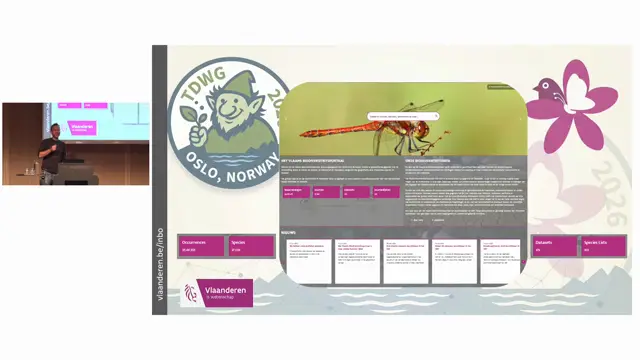
Role-Based Access Control (RBAC) for RASD: The Flemish Biodiversity Portal Approach
The Flemish portal implements restricted access through role-based access control, with institutions rather than the portal team deciding who may see high-resolution data.
Reconsidering the original vision for a global biodiversity information facility
GBIF achieved its 1999 vision only partially and through a network of collaborating infrastructures; the community must decide whether that is enough and articulate the next vision.
From NetCDF to Web Maps: Building an Open-Source Web GIS for Biodiversity Data Cubes
A simple open-source stack of NetCDF, THREDDS/ncWMS and vanilla JavaScript makes multidimensional biodiversity data cubes browsable and analysable in the browser.