
Robots Rapidly Writing Records: Machine Annotations at Scale with DiSSCo
Soulaine Theocharides · Bots, Bits, and Biodiversity
Summaries and key moments are machine-produced. Check the recording for the speaker’s exact words.
The short versionDiSSCo can now run adapted machine annotation services over whole datasets, pointing to an image-to-verified-data digitisation pipeline.
What this was about
Soulaine Theocharides explained that DiSSCo harmonises collections data from many institutions so machine annotation services, adapted once, can serve all partners, avoiding duplicated development. Pilot services include plant organ detection (LeafMachine), links to GBIF/ENA/GeoCASe, georeferencing with GeoPick, and label transcription to Darwin Core using a vision model; DiSSCo can now run services over entire datasets at once. The envisaged pipeline ingests only images, runs services, lets remote experts annotate, and returns verified data to institutions. In Q&A she explained that data come from member countries under CC0 or CC BY.
Why it matters. Shows how shared infrastructure lets institutions reuse AI services at scale instead of building their own.
In the room
- Digitisation is getting harder to scale; institutions work independently and duplicate effort.
- DiSSCo brings institutions' data into one structure so services can be reused by all partners.
- Pilot machine annotation services on the sandbox: LeafMachine plant organ detection, linking to GBIF, ENA and GeoCASe, GeoPick georeferencing, and label transcription into Darwin Core; none developed by DiSSCo, all adapted.
- New: running services over entire datasets at once rather than per specimen.
- Pipeline goal: ingest images, run services, remote human experts annotate, verified data returned to institutions (export exists; return in development).
- Virtual hackathon next month for connecting services; DiSSCo is becoming an ERIC to enable service level agreements.
Notable moments
Transcript
Automatically generated captions can contain mistakes, especially in names and technical terms. Times are relative to the room recording.
Read the transcript ↓
Related talks.
Closing the Loop: The DiSSCo Annotation Validation Framework for Trustworthy Data Round-Tripping
DiSSCo proposes impact-based, layered validation so trusted annotations are promoted automatically and only high-impact ones need expert review.
Accelerating specimen identification through Virtual Collections while promoting collaboration
Virtual reference collections with DOIs let experts identify and curate dispersed digital specimens remotely instead of shipping material or travelling.
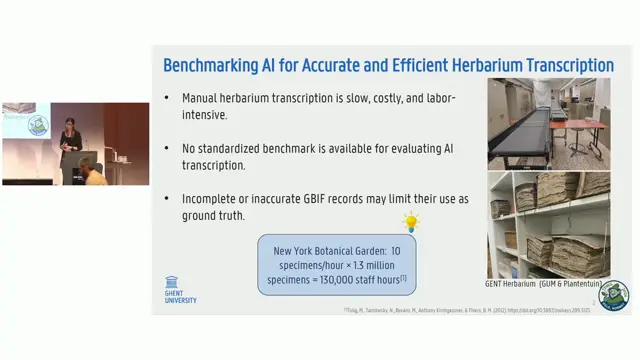
HerbAudit: Validating AI-Driven Herbarium Transcriptions
HerbAudit shows AI herbarium transcription reaching ~94% accuracy and provides a fair, field-aware way to benchmark it.