
Here, There, and Everywhere: Modelling Research Expeditions in Wikidata
Sabine von Mering · Responsible AI, Open Digital Curation, and Round-Tripping for Biodiversity Data
Summaries and key moments are machine-produced. Check the recording for the speaker’s exact words.
The short versionTreat research expeditions as first-class entities with Wikidata identifiers so distributed specimens, people, publications and archives can be linked.
What this was about
Sabine von Mering presented on behalf of the TDWG Research Expeditions task group (Collection Descriptions Interest Group). Expedition data are fragmented across institutions and lack persistent identifiers, hindering provenance and historical, including colonial, contextualisation. The group has a draft definition of a research expedition, promotes Wikidata QIDs as identifiers for expedition parent events, and proposes a lightweight, extensible Wikidata schema with minimum properties, links to holding collections and archives, and knowledge-graph visualisation (e.g. Scholia for the Harriman Alaska Expedition). Recommendations: create or enrich expedition items, use minimum properties, and record QIDs in collection management systems.
Why it matters. Improves discoverability and provenance of expedition-derived collections and supports historical and colonial-context research.
In the room
- Expeditions were often transdisciplinary, so specimens, ethnographic objects and archives are scattered across institutions.
- The terms research/scientific expedition are not unproblematic given colonial, economic and military entanglements.
- Working definition: an organised, time-bounded field activity by one or more people at one or more locations, affiliated with an institution, for research purposes, distinct from routine collecting (still a draft).
- In GBIF an expedition can be an event, linked via parentEventID; some datasets already use Wikidata QIDs; longer-term explicit Darwin Core support is being considered alongside DwC-DP.
- Minimum recommended Wikidata properties: instance of, start/end time, country, participants, collection items at, archives at; extensible with funder, field of work, itinerary etc.
- Links to holding collections can reference specimen PIDs; archival material (logbooks, field books, correspondence) and finding aids are recorded.
- Scholia knowledge graph of the Harriman Alaska Expedition shows participants, publications and collections.
Notable moments
Transcript
Automatically generated captions can contain mistakes, especially in names and technical terms. Times are relative to the room recording.
Read the transcript ↓
Related talks.
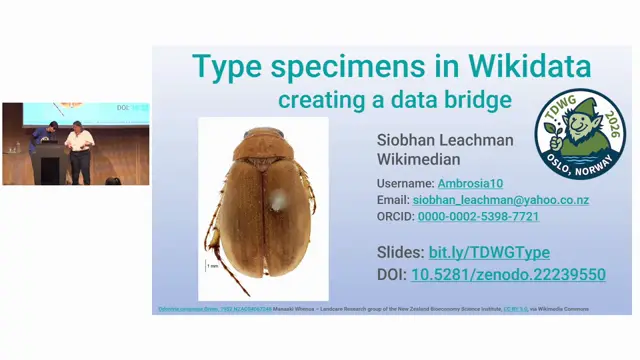
Type specimens in Wikidata
A consistent Wikidata type specimen model lets anyone link type specimens to collectors, publications, taxa and identifiers as a transparent finding aid.
SpecifyaaS: Managing Ephemeral Repositories in Collections-Based Research
Giving researchers their own lightweight Specify instances early in the research process standardises data from the start and eases later exchange with the institutional collection.
Biological occurrence data from historic scientific correspondence: enabling automated approaches for structured data extraction from body text
A Darwin Core-aligned annotated corpus from MfN journals provides a reference for evaluating automated occurrence extraction from historical texts.