talk · Tuesday 22 September · 10:00–⁠10:15 · SAL B

A new standard for restricted access (sensitive) species data

Tania Laity · To see or not to see - that is the question. Managing restricted access data (RASD)

Recording time 1:18:16–1:35:04Open on Vimeo ↗

Summaries and key moments are machine-produced. Check the recording for the speaker’s exact words.

The short versionA proposed Darwin Core extension would record why data were restricted and what treatment was applied, in a one-to-many way similar to MeasurementOrFact.

Go back to 2025Data Package pilot · 1 connection

Revisit Living Data 2025 alongside this talk. These connections were checked against captions; related examples may come from different teams rather than a direct follow-up.

Related example
2025 Living Data

The panel says DwC-DP usage policy does not yet solve Indigenous-data concerns and needs to evolve.

Watch 2025 at 1:23:51 ↗
Read the source captions

Part 1 Q&A: effort, identifiers, complexity for users, Indigenous data, interactions, EML and extended specimens

over here. There's one over here, too. >> Go ahead. Sorry, I didn't get the question. >> That's okay. Hi. Um, my name's Jane Anderson. I'm from Local Context, and I just wanted to ask both uh thank you for the presentations and for the case studies. I wanted to ask um the for the case studies, how you might have been dealing with indigenous data and just pulling a thread through from the keynote this morning. And then this uh possibility of the data package uh opening up space for indigenous interests to be uh included. I just wonder how you're thinking about that as well. >> Very good question. Um the first and simplest answer is that we haven't gone through a proper use case and so there isn't a proper solution to all of the concerns that come up. However, there are working groups in Tadwig that are interested in these things. Um, one of which is sensitive data that can be >> I won't cross the lines here with the same kinds of concerns that you're talking about. So as >> this one >> star for maintenance group which is kind of responsible for all all of this we're aware of and trying to make sure that the solutions that are that come up there end up in the data package as well and it's middle stages in terms of determining how that works and also about integrating the care principles for example into uh usage policy. No, I I would never claim that usage policy as it stands in Dracore data package solves the kinds of issues that will arise there, but it needs to. And as all Darmman core things, it's a standard that's meant to evolve. An online question from Urit Pulen. I'm
2026 This talk

Tania Laity’s restricted-data proposal includes First Nations cultural significance in its reasons vocabulary.

Open on Vimeo ↗
Read the source captions

A new standard for restricted access (sensitive) species data

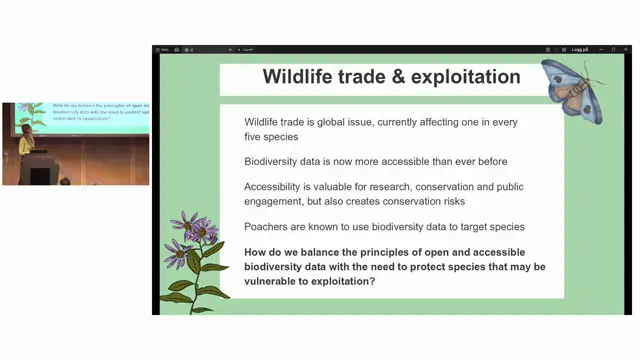
the administration that you're dealing with. So as you can see there as an example. So the RASD reasons that we've come up with to form the vocabulary. So they're things like personal information and privacy, which may either be a lack of consent or someone's asked for request for privacy for their information. Sensitive species location, so this might be where a species is highly restricted, there's a threatened population, there's exposure via survey information. Don't know why it went-- Or a potential harm to people or property, or there might be a lack of information about the species. Biosecurity risk, so there might be trade species or invasive species. Species attributes might be something that might need to be restricted. So other people have talked about things like roosting sites or nesting occurrences. So that sort of information might be something that might be restricted within a record, not the whole record itself. And there may be usage restrictions on the data. So there might be a legal contract or other reasons for withholding the data or generalizing the data in some way. And last but not least, First Nations cultural significance. So there might be culturally significant species or significant information, or it might be a particularly sensitive or significant location, such as a sacred site.

The later talk provides related, concrete work on expressing reasons for restrictions.

About this connection

This does not resolve the broader CARE, sovereignty or community-authority question. The 2026 speaker traces the task group to a 2023 workshop, so no causal origin in the 2025 discussion is inferred.
This pilot covers one 2025 symposium and selected 2026 moments. Automatic captions can contain mistakes; audio has not been checked.

Overview

What this was about

Tania Laity presented the work of the TDWG Sensitive Species Extension Task Group (convened by the ALA, GBIF and Gaia Resources), which arose from a 2023 Hobart workshop and is building on Arthur Chapman's work. The group has drafted hierarchical vocabularies of RASD reasons (privacy, sensitive location, harm, biosecurity, species attributes, usage restrictions, First Nations cultural significance) and treatments (coordinate obfuscation, attribute generalisation, date generalisation, withholding and embargo). She showed how treatments attach to records in Darwin Core Archives (as a star-schema extension) and Darwin Core Data Package (via join tables), walked through the treatment fields, and demonstrated a cave case study with a troglobitic spider, fossils and undescribed mites.

Why it matters. Would give data users visibility of restrictions and reasons across providers and aggregators, supporting FAIR handling of restricted data; submission to TDWG was planned by end of year.

Key ideas

In the room

  • Task group first met in September 2024; conveners from ALA (Cam Slatyer, Tania Laity, Simon Sharon), GBIF and Gaia Resources; members from government, universities, data providers and aggregators in several countries.
  • The group prefers 'restricted access species data' over 'sensitive' because 'sensitive' makes people reluctant to share.
  • Reason vocabulary: personal information and privacy; sensitive species location; potential harm to people or property; biosecurity risk; species attributes (e.g. roosting or nesting sites); usage restrictions (legal contracts); First Nations cultural significance.
  • Hierarchical treatment vocabulary: coordinate obfuscation (truncation to grid, snapping to polygon centroid, randomising), generalising attributes (taxon level, locality text), generalising dates (month, year, decade), withholding records/attributes/datasets and embargoes.
  • A treatment needs a reason; one reason may need several treatments; a record may have several reasons - applied one-to-many like the MeasurementOrFact extension.
  • In Darwin Core Archive, treatments are an extension pointing to the core; in Darwin Core Data Package, a treatment class is joined to events or occurrences via join tables (e.g. event-treatment).
  • Treatment fields include target field, treatment reason, treatment type, free-text description, start and end dates (for embargoes), treatment organisation and a contentious 'treatment in effect' flag.
Jump in

Notable moments

In their words

Transcript

Automatically generated captions can contain mistakes, especially in names and technical terms. Times are relative to the room recording.

Read the transcript ↓
Loading transcript…
Programme abstract

A new standard for restricted access (sensitive) species data

Tania Laity

There is growing concern among many organisations and researchers about so-called sensitive species or restricted access species data (RASD), that is, data that needs to be modified or withheld from the general public. This data is intrinsically difficult to share or display and the existing Darwin Core fields no longer give data managers the flexibility to deal with the diverse array of emerging issues that managers encounter. Following a workshop in 2023, a Darwin Core Task Group was established on sensitive species data. The Task Group has developed a suite of reasons and treatments and an underlying vocabulary that enables data managers to communicate what has happened to restricted data and why in line with FAIR principles. The data extension is intended to handle a wide range of reasons for restricted access and a similarly wide range of treatment options that can be applied to the data. This proposed data extension paths the way for institutions, regions or countries to develop a consistent approach to the management of restricted data. We will outline and discuss the new restricted access species data extension, including solutions for both Darwin Core Native and Darwin Core Data Packages.

Submitted to the conference programme before the talk, so the talk itself may differ.