Related example
ABCD community support → a DWB mapping prototype
2025 Living Data
Anton Güntsch welcomes relational data exchange through DwC-DP and says the BioCASe help desk will extend support to it.
Watch 2025 at 31:08 ↗Read the source captions
Two Decades of ABCD: Advancing Structured Biodiversity Data Sharing
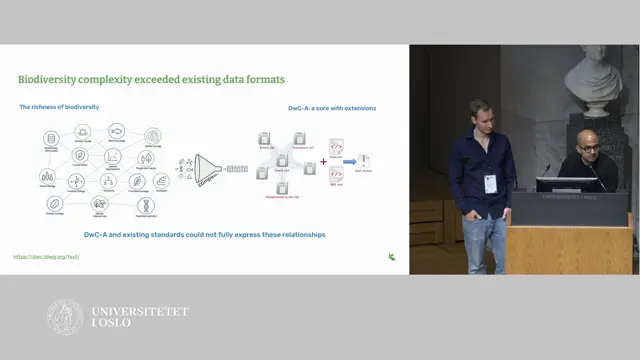
and transmitting relational structures over the internet uh finally comes true. So what we would like to do as a bioase ABCD initiative is really to support this initiative for example for example by contributing to the development and maintenance of the ding code data package standard and also uh for developing templates for typical usage scenarios. We will however continue the bioase help desk. So we will not let the bioase ABCD providers alone but we will extend the focus of this help desk to structured uh highly structured data complex data using the DAC data package technology and um I can now can't read more what here on the slide um yeah that's actually again that we want to to integrate the Darving core data package structures into our help desk uh uh structures and that's exactly what I wanted to say.
2026 This talk
Tanja Weibulat shows mapping Diversity Workbench’s PostgreSQL tables to DwC-DP using the test IPT.
Open on Vimeo ↗Read the source captions
Mapping the Relational Data Schema of the Diversity Workbench (DWB) to the Darwin Core Data Package Data Model to fit better to GBIF´s New Data Model
tool and the Darwin Core Data Package instead of ABCD. So we get a Darwin Core Data Package. So we tried it. We installed an IPT, not the official one, but a test version, because only the test version includes, at the moment, the Darwin Core Data Package. So we were installing the test version of the IPT, and that's what was our first step. So that's a screenshot of the IPT installation. So first, we added our source data. What you can see here are all the tables from the Diversity Workbench, from the PostgreSQL data. So we accessed it directly via SQL. And second, we had to do the mapping of all this data. So the first one is always the Diversity Workbench table, and the second one is the Darwin Core Data Package table. And as you can see, it's often quite similar, but not all the time. So for example, we need to separate our observation data and the physical specimen data. That's separated here in the Darwin Core Data Package. It was together in the original one, and it leaded to occurrence data and material data down here. Then some things have been together. They share, for example, the event up here, the identification, and also the agents. And then we had to unite some informations like, for example-- Oops, sorry. This was not what was I want to be. So we have here our analysis and up here
A later example shows practical exploration of DwC-DP in an ecosystem that previously published through ABCD/BioCASe.
About this connection
Different presenters and projects are involved. This does not show that the earlier pledge caused this prototype, or that ABCD was abandoned.