
Digitising Plant and Fungal Collections at Royal Botanic Gardens, Kew: Applying International Standards to Support Data Sharing and Geospatial Analysis
Udayangani Liu · From WDSRPD to GeoSchemes: Recording Biodiversity Distributions for Science and Policy
Summaries and key moments are machine-produced. Check the recording for the speaker’s exact words.
The short versionWGSRPD enables cross-collection geospatial analysis at Kew, but historical, heterogeneous data leave half of records without fine-level assignment.
What this was about
Udayangani Liu presented how Kew applied WGSRPD in its Integrated Collections Management System after a four-year mass digitisation that imaged over six million herbarium and fungarium specimens. Selecting an ISO country semi-automatically populates TDWG levels, while transcontinental countries, multi-country archipelagos and changed boundaries need level-by-level handling. Analysis of 7.9 million records spanning five centuries showed ISO codes are well captured but only just over 50% have levels three and four, with about 1.5 million records lacking a continent; challenges include historical data, missing hierarchy, language and variable user familiarity with the scheme.
Why it matters. It is a real-world large-scale application of the standard being revised, surfacing practical issues the new version must accommodate.
In the room
- Kew holds over 8 million items across 12 collections; ICMS manages them in one system following TDWG, Darwin Core and other protocols.
- Over six million records were added in the mass digitisation project.
- Choosing an ISO country auto-populates TDWG levels; large countries require state/province choice.
- About 70% of records capture collecting year; dates span five centuries with dips during the World Wars.
- Just over 50% of records capture TDWG levels three and four; ~1.5 million (20%) lack continent.
- Data shared via Kew Data Portal, GBIF, DiSSCo UK, Genesys and the Svalbard Seed Vault.
Notable moments
Transcript
Automatically generated captions can contain mistakes, especially in names and technical terms. Times are relative to the room recording.
Read the transcript ↓
Related talks.
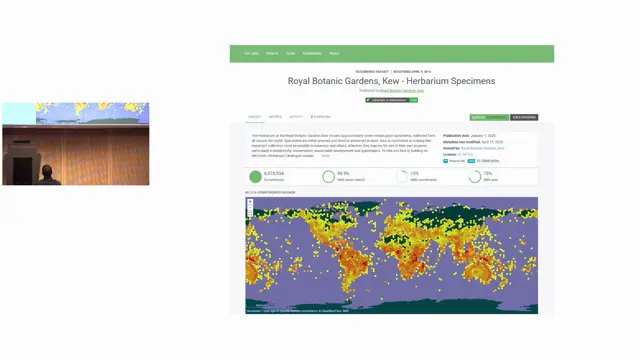
Geonomia: Metadata and Community for Georeferencing
Clustering specimens into collecting trips makes georeferencing and AI enrichment more efficient and should be done as a community effort.
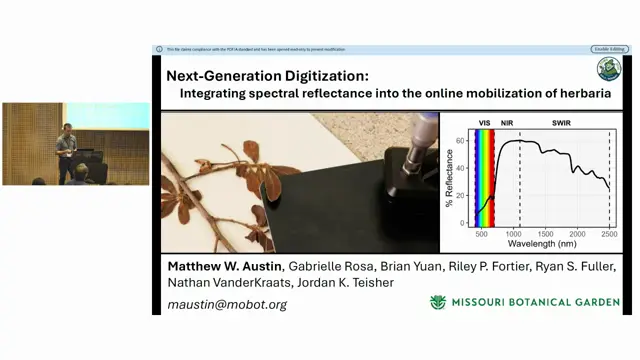
Next-generation digitization: integrating spectral reflectance into the online mobilization of herbaria
Spectral reflectance can be captured at scale during herbarium digitisation and supports accurate species identification from leaves alone.
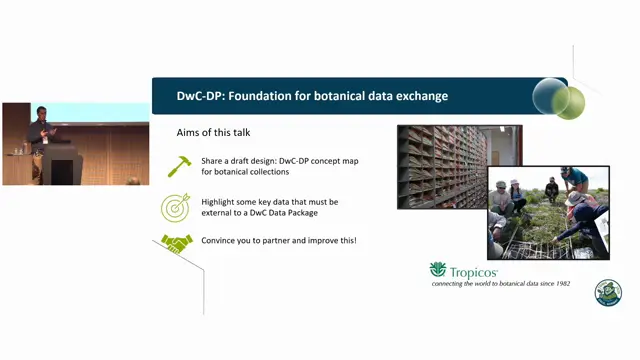
Machine-Ready Botanical Data: Mapping Integrated Collections and Traits with Darwin Core Data Package
Darwin Core Data Package can serve as a semantic integration layer for a botanical garden's diverse collections and trait data, and MBG's draft mapping is offered for community refinement.